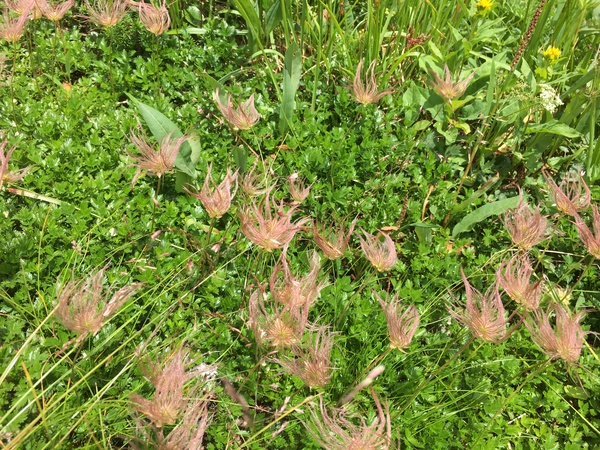
Japanese name: チングルマ(稚児車、珍車) Scientific name:Sieversia pentapetala
[Overview]
A small deciduous shrub found in alpine snowbeds, wetlands and similar places.
The stems are thin, much branched, and creep along the ground.
The leaves are alternate and odd-pinnately compound with 5–9 leaflets, about 1.5–5 cm long and 1–2.2 cm wide.
The upper surface of the leaf is glossy and both surfaces are hairless; the terminal leaflet is sometimes 3-lobed.
The leaves have petioles.
The leaves turn red in autumn.
At the tip of an upright flower stalk it bears a single white 5-petaled flower 1.6–2.8 cm in diameter.
There are many yellow stamens.
The flower stalk elongates after flowering.
The style elongates after flowering and becomes feathery.
The fruit is an achene.
[Cultivation]
Propagate from seed, by division, or from cuttings.
It prefers a sunny, well-drained, well-ventilated place; avoid places exposed to strong afternoon sun or direct summer sunlight.
In regions with severe summer heat, move it in summer to an airy place in partial shade to keep it cool.
Water thoroughly when the soil surface dries, and do not let it dry out completely even while the leaves are off in winter.
It dislikes heat and humidity, so when temperatures are high, water in the evening or later.
In spring and autumn, place slow-release fertilizer on the soil.
Pests and diseases include powdery mildew and aphids.