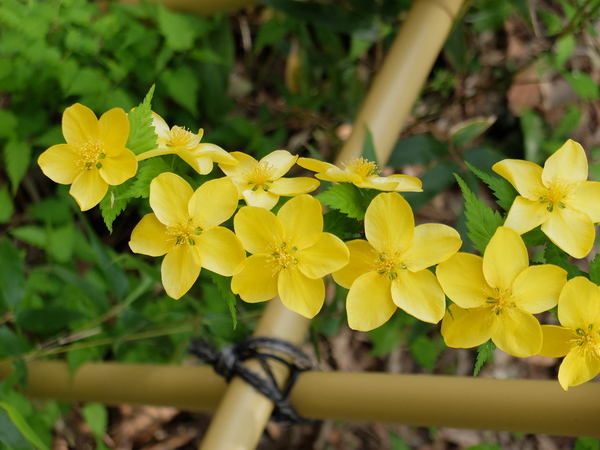
Japanese name: ヤマブキ(山吹) Scientific name:Kerria japonica
[Overview]
A deciduous shrub 1–2 m tall, found from low hills to mountains.
Many green branches arise and arch outward.
The leaves are simple and alternate, ovate, 3–10 cm long and 2–4 cm wide, thin in texture, with 5–7 pairs of conspicuous lateral veins.
The leaf margin is shallowly lobed with uneven double teeth.
The petiole is 0.5–1.5 cm long.
The flowers are yellow, 5-petaled, 3–5 cm across, and borne singly at the tips of side branches.
The flower stalk is 0.8–1.5 cm long.
There are many stamens.
The fruit is an achene that ripens brown, containing a light brown seed.
[History]
Yae-yamabuki, the double-flowered form, is famous from the "Yamabuki anecdote" of Ota Dokan.
[Uses]
It is used as a folk medicine.
[Cultivation]
Propagate by cuttings or division.
It prefers fertile soil with sun and good drainage.
For potted plants, water thoroughly when the soil surface dries; for plants in the ground, rainfall is sufficient apart from watching for summer dryness.
Apply fertilizer in winter, and also place slow-release fertilizer on the soil after flowering as a thank-you fertilizer.
Because the branches are short-lived, remove dead branches during the leafless period.
There are no particular pests or diseases.