
Plant Encyclopedia

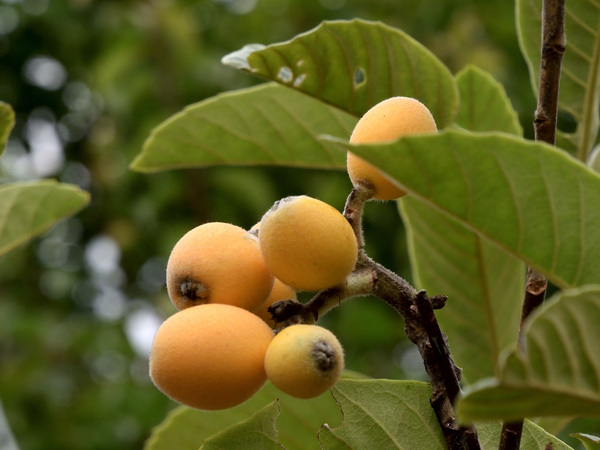
Eriobotrya japonica (loquat, "Biwa")
Japanese name: ビワ (枇杷)
Scientific name: Eriobotrya japonica
[Overview]
An evergreen tree about 10 m tall, grown as a fruit tree.
Because the lateral branches spread out, the tree takes a hemispherical shape if left alone.
The leaves are simple and alternate, oblong to oblanceolate.
The upper surface of the leaf is glossy, and the pinnate veins are conspicuous.
The underside of the leaf is densely covered with soft, pale brown hairs.
Many white, 5-petaled flowers are borne in panicles at the branch tips.
The fruit is a false fruit, round to pear-shaped and yellow-orange, with the skin lightly covered in hairs.
The edible part is the enlarged receptacle.
The seeds are large and reddish brown.
[History]
It has been cultivated in China since ancient times, and cultivars were recognized by the 6th century.
It is said to have come to Japan from China long ago and become naturalized.
The fruit was used in the Nara period, but full-scale cultivation began only at the end of the Edo period, when large-fruited cultivars were introduced from China.
[Uses]
Besides eating the fruit, the leaves are used as a bath additive and as medicine.
The wood is tough and hard to break, so it is used for combs, seals, walking sticks and the like.
[Cultivation]
Propagate by grafting.
The flowers and young fruit are easily damaged by cold, so it is suited to warm regions where winter temperatures do not fall below -3°C.
The suitable area is somewhat warmer than that for Unshu-mikan.
It prefers a sunny, well-drained, fertile site.
For plants in the garden, watering is not particularly necessary.
Apply organic fertilizer or fast-acting chemical fertilizer in February, June and September.
If pruning, do it around August–September.
Thin the buds in mid-October and thin the fruit in March–April; after thinning, cover the fruit with bags.
Long rains at harvest time cause fruit drop and fruit splitting.
Pests and diseases include canker, gray spot, rust, headband disease, peach weevils, stink bugs and longhorn beetles.
Details
Japanese: ビワ(枇杷)
Translated from our Japanese encyclopedia. If anything differs, the Japanese page is correct.