
Plant Encyclopedia

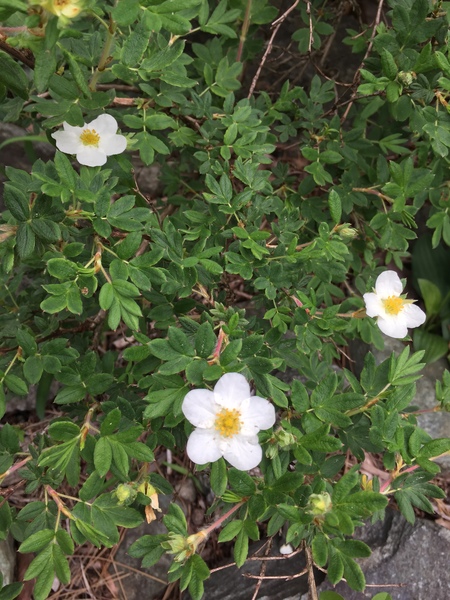
Dasiphora fruticosa var. mandshurica ("Hakurobai")
Japanese name: ハクロバイ (白露梅)
Scientific name: Dasiphora fruticosa var. mandshurica
[Overview]
A deciduous shrub 0.1–1 m tall, found on sunny, dry rocky ground of serpentine or limestone in subalpine to alpine zones.
In its native habitat it spreads along the ground, but when cultivated on flat land it can reach 1.5 m in height.
The stems branch freely and the base becomes hard and woody; the bark peels off in thin pieces as it ages.
The leaves are densely alternate and odd-pinnately compound, with 3–5 leaflets.
The leaflets are oblong, 1–2 cm long and 0.3–1 cm wide; young leaves have long hairs on both sides, and the leaf margin is entire.
The petiole is slender and hairy.
Cymes at the stem tips and in the upper leaf axils bear one to several flowers.
The flowers are white, 5-petaled, 2–3 cm across, with rounded petals.
There are usually 20 stamens, which are yellow.
The receptacle is hemispherical and covered with long hairs.
There are 5 sepals and 5 epicalyx segments, which are hairy like the flower stalk.
The fruit is an achene with many hairs.
[Cultivation]
Propagate from seed, by division, or by cuttings.
It suits cool regions and prefers a sunny, well-drained, well-ventilated site.
With poor sunlight, it flowers poorly.
For potted plants, a potting mix for alpine and wild plants may be used.
Watch for summer heat and humidity when watering; for potted plants, water thoroughly when the soil surface dries, and for plants in the ground, rainfall is sufficient.
Fertilize sparingly; apply a small amount in spring and autumn, watching how the plant responds, and make sure no fertilizer remains in midsummer.
Pests and diseases include aphids and spider mites.
Details
Translated from our Japanese encyclopedia. If anything differs, the Japanese page is correct.