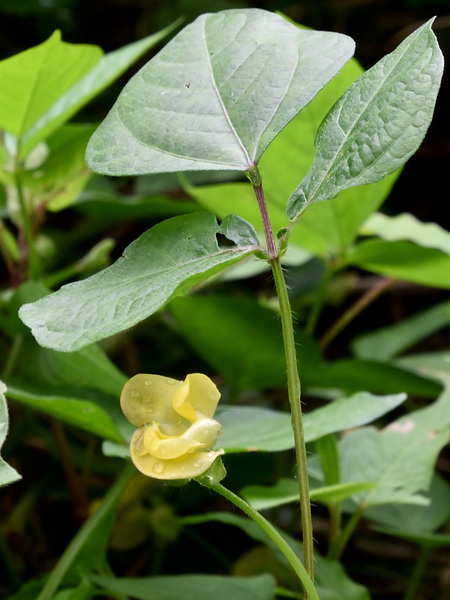
Japanese name: ノアズキ(野小豆) Scientific name:Dunbaria villosa
[Overview]
A climbing perennial found in sunny, slightly moist places in grasslands and at woodland edges.
The whole plant has velvety hairs and orange glandular dots.
The leaves are alternate and pinnately trifoliate; the leaflets are rhombic-ovate, 1–3 cm in both length and width, with a slightly elongated tip.
The stipules are triangular.
Racemes arising from the leaf axils bear yellow pea-like flowers.
The standard petal is large and asymmetrical.
The keel petals curve back in a hook shape.
The calyx has glandular dots and soft hairs, and is unequally 5-lobed, with the dorsal lateral lobe being the largest.
The fruit is a flat, broadly linear pod 4.5–5.5 cm long, densely covered with short hairs.
The pod splits into two when ripe.
It contains 5–8 seeds.
Japan (Honshu: Miyagi and west to Kyushu, Amami Oshima, Ryukyu: Iejima, Okinawa Island; Ogasawara), Korea, China to India, Taiwan, Philippines, Indonesia
Growth form
Climbing
Leaf arrangement
Alternate
Inflorescence
Raceme
Flower color
Yellow
Leaf color
Green
Translated from our Japanese encyclopedia. If anything differs, the Japanese page is correct.