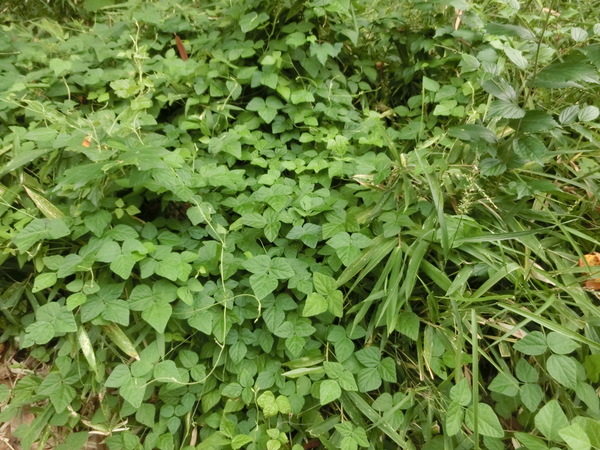
Alysicarpus bracteata subsp. edgeworthii f. alba("Shirobanayabumame")
Japanese name: シロバナヤブマメ(白花薮豆) Scientific name:Alysicarpus bracteata subsp. edgeworthii f. alba
[Overview]
A climbing annual often seen in slightly dry places such as roadsides and woodland edges.
The stem twines to the right around other objects and has downward-pointing hairs.
The leaves are alternate and trifoliate; the terminal leaflet is ovate to broadly ovate, 3–9 cm long and 2–6 cm wide, with short white appressed hairs on both surfaces.
The petioles are hairy.
A pseudoraceme arising from the leaf axils bears several white pea-shaped flowers about 1.5–2 cm long.
It also bears closed flowers, which are solitary in the leaf axils, grouped in twos or threes, or borne several together in a raceme.
Underground closed flowers are also borne on the underground stems and at the tips of branches that extend into the soil from leaf axils near the ground surface.
The legumes borne above ground are flat, narrowly oblong, 2.5–3 cm long, hairy on the margins, and contain 2–4 seeds.
The seeds are brown with black spots and flat and round.
The legumes formed underground are rounded and swollen, densely hairy, and contain 1 seed, which is larger than those of the aboveground ones.