
Plant Encyclopedia

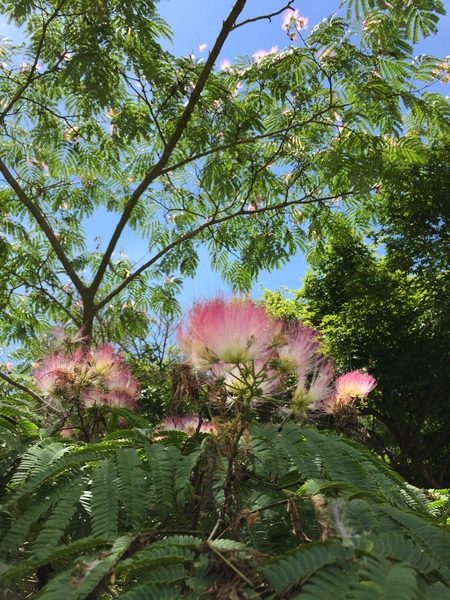
Albizia julibrissin var. julibrissin (silk tree, "Nemunoki")
Japanese name: ネムノキ (合歓木)
Scientific name: Albizia julibrissin var. julibrissin
[Overview]
A deciduous tree growing in sunny wet places such as forest edges and fields.
It reaches more than 10 m in height.
Leaves are alternate and twice evenly pinnately compound, with 7–9 pairs of nearly opposite pinnae 5–15 cm long.
Each pinna bears 15–30 pairs of narrowly ovate-elliptic leaflets about 10–17 mm long and 4–6 mm wide.
The leaflets are pointed at the tip and entire, with hairs on the margin and on the midrib of the underside.
The bases of the petioles and leaflet stalks are swollen and are called pulvini.
Because the turgor pressure of the cells in the pulvini changes between day and night, the leaves show sleep movements and close at night.
A rather large nectary is found at the base of the petiole.
Conical clusters of flower heads are produced at the branch tips, each head bearing 10–20 flowers.
The long, pale pink stamens stand out like a brush.
The fruit is a flat pod 10–15 cm long and 1.5–1.8 cm wide, containing 10–18 flat, elliptic seeds.
[Uses]
The bark is used medicinally.
[Cultivation]
Propagate from seed, root cuttings, or grafting.
Plants grown from seed take about 10 years to flower.
It prefers a sunny, well-drained, fertile site.
It flowers better in a sunny place.
For potted plants, water thoroughly when the soil surface dries.
For plants in the garden, watering is not particularly necessary.
Fertilizer is not particularly necessary.
It is somewhat sensitive to cold.
It grows even in poor or dry soil and tolerates strong wind.
Avoid transplanting mature trees.
Pruning is not particularly necessary, but if desired, simply thin out any branches that are in the way.
Pests and diseases include sooty mold and scale insects.
[Notes]
The Japanese name derives from the way the leaves close at night as if sleeping.
Details
Japanese: ネムノキ(合歓木)、ネム
Translated from our Japanese encyclopedia. If anything differs, the Japanese page is correct.