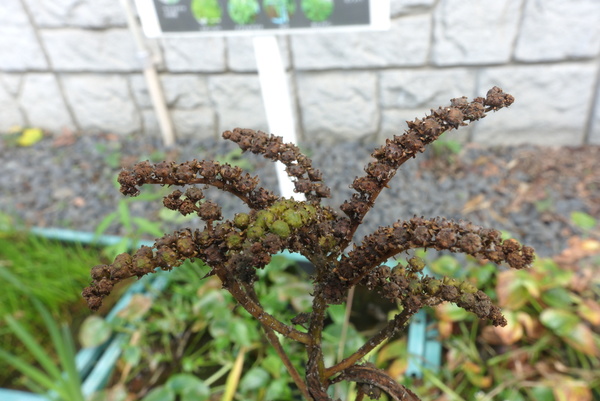
Japanese name: タコノアシ(蛸足) Scientific name:Penthorum chinense
[Overview]
A perennial 30–80 cm tall, found in wet places such as marshes, rice paddies, swamps and riverbanks.
It produces underground stems.
The stem is unbranched and erect, usually tinged with pale pink.
Leaves are simple and alternate, lanceolate to elliptic, 6–11 cm long and 0.5–1.2 cm wide, with a sharply pointed tip.
The leaf margin has fine serrations.
Cymes arise at the stem tips and from the leaf axils, with the flowers lined up in a single row on the upper side of the flower branch.
The flower branch is 4–12 cm long and at first coils outward in a spiral, gradually unrolling.
The flowers are yellowish green, 0.4–0.5 cm across, and have no petals.
The fruit is an ovate capsule 0.6–0.7 cm across.
[Uses]
It is used medicinally.
[Cultivation]
Propagate by division.
Plant it in a sunny place that is always moist.
From spring to autumn, apply slow-release fertilizer or oil cake once a month.
[Notes]
The Japanese name compares the shape of the inflorescence to octopus legs.