
Plant Encyclopedia

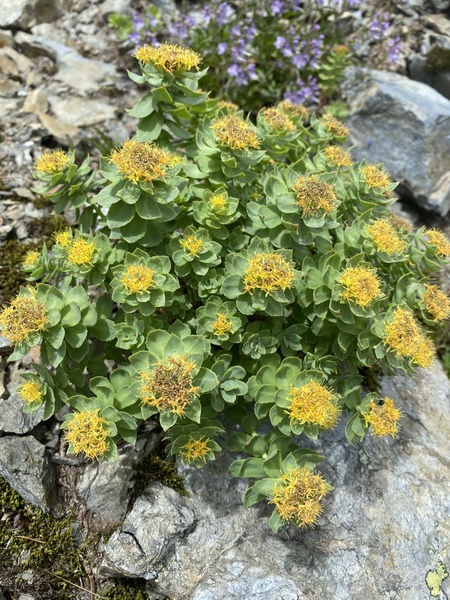
Rhodiola rosea (golden root, "Iwabenkei")
Japanese name: イワベンケイ (岩弁慶)
Scientific name: Rhodiola rosea
[Overview]
A perennial 10–30 cm tall, found in alpine areas and on rocky northern coasts.
It has a thick, burdock-like rhizome.
The tip of the rhizome emerges above ground, and brown, triangular scale leaves grow densely from the base.
Every year flower stems rise from the axils of the scale leaves, and these, together with the leaves, are tinged with a powdery white.
The leaves are simple and alternate on the flower stem, lanceolate to ovate, 1–4 cm long and 0.6–2 cm wide, and thick.
The leaf shape is highly variable.
The leaf margin has a few irregular low serrations or is entire.
There is no leaf stalk.
The plant is dioecious.
A cyme at the tip of the flower stem is densely covered with yellow-green flowers with 4 petals.
The petals of male flowers are longer than the calyx, and those of female flowers are shorter than the calyx.
The fruit is a red follicle.
[Uses]
Overseas it has long been used as a folk remedy, and the leaves and buds are also used as a vegetable.
[Cultivation]
Propagate by division.
It prefers sunny, well-drained sandy soil.
For potted plants, place them in a well-ventilated spot out of the rain during long rainy spells, and in a cool, well-ventilated spot in summer.
For potted plants, in spring and autumn water thoroughly several days after the soil has dried, water sparingly in midsummer, and in winter withhold water because the aboveground part dies back and the plant goes dormant.
For plants in the ground, rainfall is sufficient.
Poor ventilation or excess moisture causes root rot.
Fertilizer is not particularly necessary.
Pests and diseases include powdery mildew and scale insects.
Details
Japanese: イワベンケイ(岩弁慶)、イワキリンソウ(岩麒麟草)、ナガバノイワベンケイ(長葉岩弁慶)、イワベンケイソウ(岩弁慶草)
Translated from our Japanese encyclopedia. If anything differs, the Japanese page is correct.