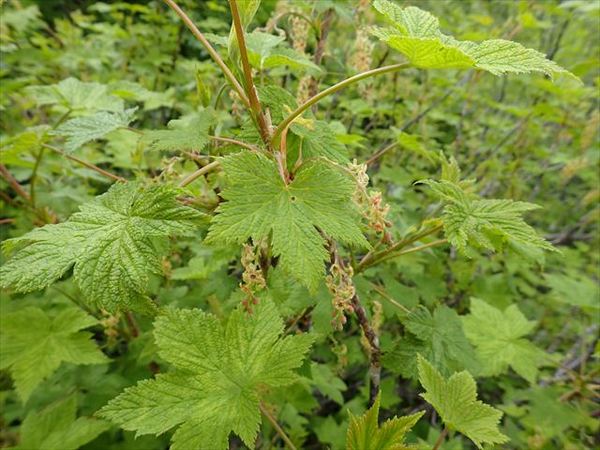
Japanese name: フサスグリ(総酸塊) Scientific name:Ribes rubrum
[Overview]
A deciduous shrub that can reach 2 m in height.
Young branches have soft hairs and glandular hairs, but later become hairless.
The bark splits lengthwise and peels off, turning blackish purple.
The leaves are alternate, 3–8 cm long and wide, and shallowly 3–5-lobed.
Both surfaces of the leaves have soft hairs, and the margin has teeth or double teeth.
The petiole is 2.5–4 cm long and fairly densely covered with soft hairs and glandular hairs.
Racemes 5–10 cm long arise from the leaf axils of the previous year's branches and bear yellowish white flowers.
The fruit is spherical and ripens red.
[Uses]
The leaves are used medicinally, and the fruit is used for jam, jelly, juice and the like.
[Cultivation]
Propagate by division or by cuttings.
It suits a cool climate and prefers a sunny site with soil that is well drained and retains moisture well.
Rainfall is sufficient for watering unless summer brings a long spell of sunny weather and the soil becomes dry.
Apply organic fertilizer in winter, and also place fertilizer on the soil in autumn.
Pests and diseases include powdery mildew and scale insects.