
Plant Encyclopedia

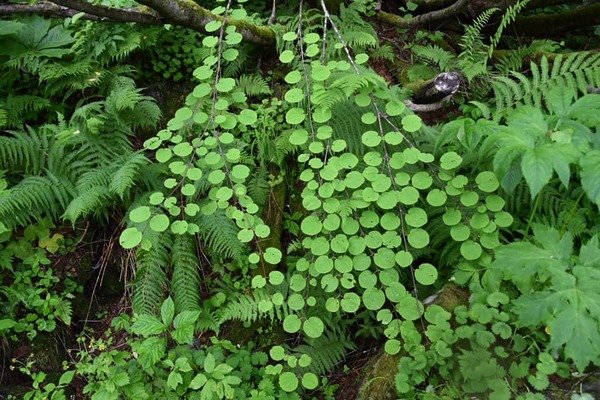
Cercidiphyllum japonicum (katsura)
Japanese name: カツラ (桂)
Scientific name: Cercidiphyllum japonicum
[Overview]
A deciduous tree found along mountain valleys, growing up to 30 m tall and 2 m in diameter.
It often forms multiple trunks.
The bark is shallowly fissured lengthwise.
It has long shoots and short shoots; the leaves are usually opposite on the long shoots, and one leaf grows on each short shoot.
The leaves are simple, round heart-shaped, about 3–8 cm both in length and width, with palmate veins and blunt teeth, and the undersides are tinged powdery white.
The petiole is 2–4 cm long and reddish.
The leaves turn yellow in autumn, and the fallen leaves have a sweet scent.
It is dioecious.
The flowers open before the leaves unfold; both male and female flowers grow on short shoots and have neither petals nor sepals.
The male flowers have about 30 hanging stamens with red to reddish purple anthers, and the female flowers have 3–5 red pistils; both have a membranous bract at the base.
The fruit is a slightly curved follicle with a slender beak at the tip.
The seeds have a wing on one side.
[History]
It is mentioned in the Man'yoshu and The Tale of Genji.
[Uses]
The wood is used for construction, furniture, pencils and the like, and also for go boards and shogi (Japanese chess) boards.
At the Aoi Festival in Kyoto, it is used together with Futaba-aoi in a decoration called "Aoi-katsura."
[Cultivation]
Propagate from seed, sown immediately after harvest or stored in a cool, dark place sealed in moistened sand or similar so that it does not dry out, and sown the following spring.
It prefers sun to partial shade and fertile soil that is well drained and moderately moist.
It dislikes extreme dryness.
It is also sensitive to sea wind and air pollution.
For potted plants and plants in the ground for less than 2 years, water thoroughly when the soil surface dries.
For established plants in the ground, rainfall is sufficient unless sunny summer weather continues and the soil dries out.
Apply organic fertilizer around the plant in winter.
Pruning is hardly necessary, but if done, thin out branches during the leafless season.
There are no particular pests or diseases.
[Notes]
Because it grows into a large tree, some specimens are designated as natural monuments.
Details
Japanese: カツラ(桂)、トワダカツラ
Translated from our Japanese encyclopedia. If anything differs, the Japanese page is correct.