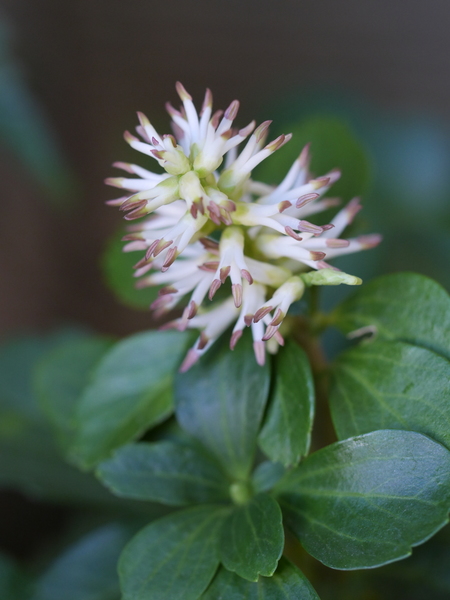
Japanese name: フッキソウ(富貴草) Scientific name:Pachysandra terminalis
[Overview]
An evergreen subshrub 20–30 cm tall, found in mountain forests.
The stem is green, creeping along the ground in the lower part, branching well, and rising in the upper part.
The leaves are simple and alternate, obovate, 3–8 cm long and 1.5–4 cm wide.
The leaves are thick and glossy.
The upper half of the leaf has 1–4 pairs of coarse teeth.
The flowers are either male or female.
A spike 3–5 cm long at the stem tip bears 15–25 male flowers in the upper part of the inflorescence and 1–7 female flowers in the lower part.
Both male and female flowers have no petals, and the white stamens and pistils are conspicuous.
The fruit is an ovoid drupe 1.5 cm long, ripening white, with 2 styles remaining.
[Cultivation]
Propagate by division or by cuttings.
It prefers partial shade and well-drained soil.
It can also be grown in full sun, but strong direct sunlight may scorch the leaves.
For potted plants, water thoroughly when the soil surface dries; for plants in the ground, rainfall is sufficient.
For plants in the ground, fertilizer is unnecessary if base fertilizer is applied; for potted plants, place slow-release fertilizer on the soil in spring and autumn.
There are no particular pests or diseases.
[Notes]
The leaves stay lush all year round, which was taken to signify prosperity, and so it received the name fukigusa.