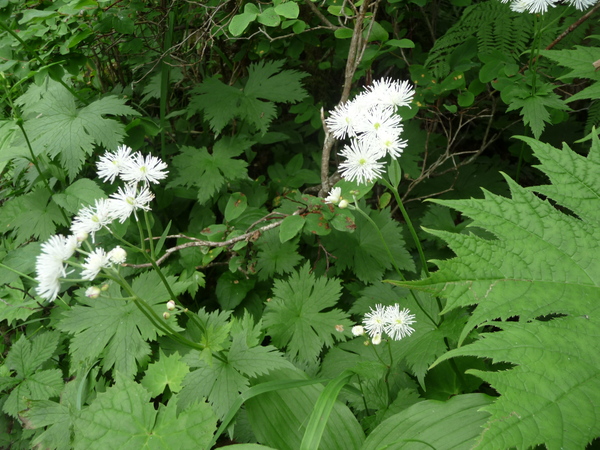
Trautvetteria caroliniensis var. japonica("Momijikaramatsu")
Japanese name: モミジカラマツ(紅葉唐松、紅葉落葉松) Scientific name:Trautvetteria caroliniensis var. japonica
[Overview]
A perennial 15–100 cm tall, found at forest edges and in grasslands in the high mountains.
It has a short rhizome and often sends out creeping stolons.
There are basal leaves and stem leaves; the basal leaves are kidney-shaped, 4–30 cm across, and palmately divided into 7–9 lobes.
They have petioles 3–40 cm long.
The stem leaves have no petioles.
A corymb-like panicle bears 6–10 flowers.
The flowers have no petals; there are 3–5 white sepals, which fall early, and the many white stamens are conspicuous.
The fruit is an achene.
[Cultivation]
Propagate from seed or by division.
From autumn to spring, place it in a sunny spot; from early summer to summer, move it to a cool, airy place in partial shade to get it through the summer.
Also avoid places where strong winds blow.
It prefers fertile soil that is well drained and retains water well.
Water daily from spring to autumn; in summer, water in the evening or later when temperatures are lower, and during periods when it dries out easily, it may be watered twice, morning and night.
In winter too, water occasionally so that it does not become too dry.
In spring and autumn, place slow-release chemical fertilizer on the soil.
Pests and diseases include soft rot, powdery mildew, spider mites, aphids and cutworms.