
Plant Encyclopedia

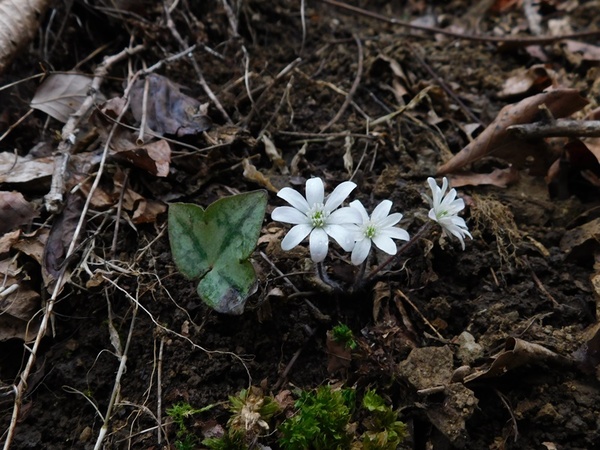
Hepatica nobilis var. japonica f. japonica ("Misumiso")
Japanese name: ミスミソウ (三角草)
Scientific name: Hepatica nobilis var. japonica f. japonica
[Overview]
An evergreen perennial 5–15 cm tall, found on slopes in deciduous forests.
It has slender creeping rhizomes.
There are both basal leaves and stem leaves.
There are 3–16 basal leaves, triangular, 1.5–4.5 cm long and 2.5–6.5 cm wide, shallowly 3-lobed, with entire margins.
The lobe tips are pointed.
The basal leaves have petioles 2.5–15 cm long.
The basal leaves persist without withering even at flowering, and flower stalks 5–15 cm tall extend from their axils, each bearing 3 stem leaves in a whorl.
The stem leaves are elliptical, 0.5–1.2 cm long and 0.3–0.6 cm wide, with no petiole.
The flower stalk and stem leaves bear white appressed hairs.
The flowers are borne singly at the tips of the flower stalks, 1–2 cm across, with no petals; the 6–10 petal-like colored sepals are conspicuous.
The sepals come in a variety of colors, such as white, pink, purple, pale blue and red.
The fruits are achenes, clustered in a shape like konpeito (sugar candy).
[Cultivation]
Propagate from seed, by division, or by root cuttings.
Sow seeds fresh, immediately after harvest.
Do not divide the plants too finely; let them separate naturally.
From winter through the flowering period, keep it in a sunny place, and once the leaves have grown, in a place with bright shade.
Take care to keep it out of direct sunlight.
When planted in the ground, under deciduous trees is best.
It prefers soil rich in organic matter that is well drained and well aerated.
Because it grows on slopes, it dislikes excess humidity and stagnant water.
For potted plants, water thoroughly when the soil surface dries.
For plants in the ground, watering is not particularly necessary unless sunny weather continues and the soil dries out.
From the time new shoots emerge until flower buds form, apply a nitrogen-rich liquid fertilizer once every 2 weeks, and from bud formation until flowering, a phosphate-rich liquid fertilizer once every 2 weeks.
After flowering, place slow-release chemical fertilizer on the soil as a thank-you fertilizer, and in autumn–winter apply a liquid fertilizer with equal amounts of the three components once every 2 weeks.
Pests and diseases include gray mold, anthracnose, viral disease, southern blight, soft rot, slugs, spider mites, root-knot nematodes and aphids.
Details
Translated from our Japanese encyclopedia. If anything differs, the Japanese page is correct.