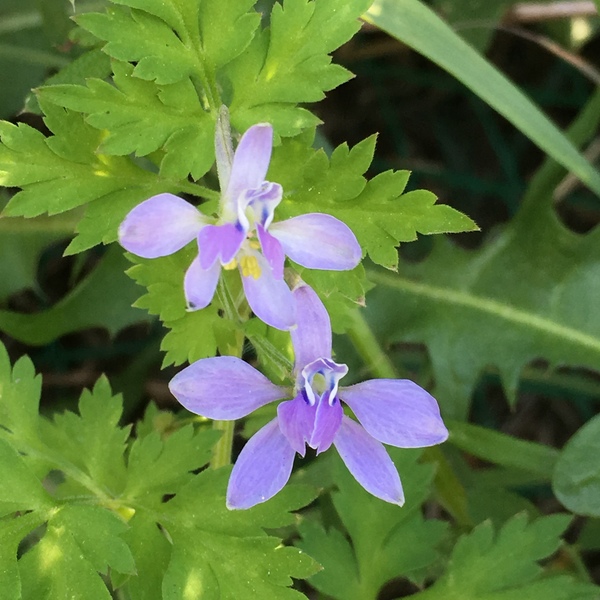
Japanese name: セリバヒエンソウ(芹葉飛燕草) Scientific name:Delphinium anthriscifolium
[Overview]
An annual 12–80 cm tall, found in grasslands and forests.
The stem branches in the upper part.
The leaves include basal leaves and alternate stem leaves, and the basal leaves have withered by the flowering period.
The leaves are 2–3 times ternately compound, about 4–8 cm wide, and the lobes are further finely divided.
A raceme 2–10 cm long is borne at the stem tip, bearing 2–10 pale purple (rarely white) flowers sparsely.
The flowers have 5 conspicuous petal-like sepals, and the upper sepal has a long tubular spur behind it.
The fruit is a follicle.
[History]
It was introduced in the Meiji era and has become naturalized, mainly around Tokyo.
[Uses]
Although poisonous, the whole plant is used medicinally.