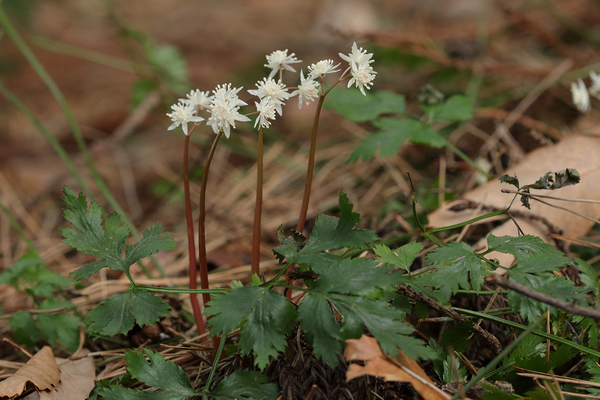
Japanese name: キクバオウレン(菊葉黄連) Scientific name:Coptis japonica var. anemonifolia
[Overview]
An evergreen perennial about 20 cm tall, found in slightly moist places in deciduous forests in the mountains.
The rhizome is thick and extends long.
The leaves are basal, once-ternately compound, thick, and glossy on the upper surface.
The leaflets are up to 7 cm long and 5 cm wide, with coarsely notched margins or shallowly pinnately lobed.
The leaves have long petioles.
The upper part of the flower stalk bears 2–3 flowers in a raceme.
There are male flowers and bisexual flowers, both white, with several sepals and petals radiating outward.
The sepals are larger than the petals and conspicuous, resembling petals.
The male flowers have many stamens.
The fruit is a follicle, arranged in a ring.
[Uses]
The rhizome has long been used medicinally.