
Plant Encyclopedia

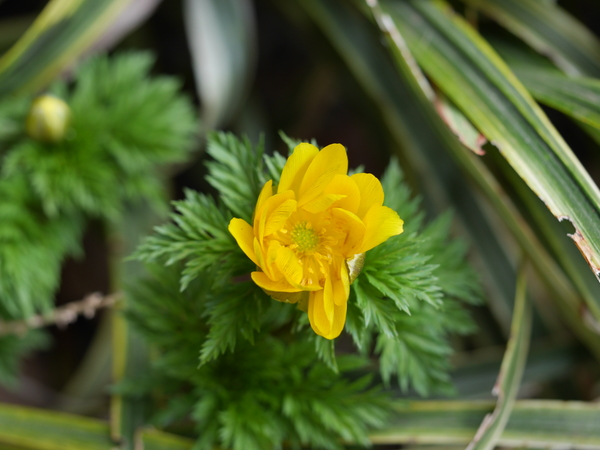
Adonis ramosa (Amur adonis, "Fukujuso")
Japanese name: フクジュソウ (福寿草)
Scientific name: Adonis ramosa
[Overview]
A perennial growing in deciduous forests.
It has a thick, short rhizome and produces many roots.
The stem grows about 15–30 cm tall; at its lower part remain large sheath-like scales that enclosed the buds, and branches emerge from their axils.
There are no basal leaves; the stem leaves are alternate and finely divided, pinnately 3–4 times.
There are small stipules at the base of the leaves.
The petioles are long.
The stem tip bears a single golden-yellow flower 3–4 cm across.
The flower stalk sometimes branches and bears several flowers.
The flowers have several sepals and 20–30 petals.
The petals are about 2 cm long and are about as long as the sepals or longer.
The flowers open in sunlight and close when it is shaded.
The flower is shaped like a shallow bowl, and it is said that it may gather sunlight at its center to warm the air, attracting pollinating insects and making them more active.
The fruit is an obovate achene 4–5 mm long.
Short hairs cover the whole fruit.
At flowering the stem has not elongated, and only the flowers sit on a short stem wrapped in bracts; the stem and leaves elongate after flowering.
By the time the surrounding trees and grasses grow thick, it has set fruit and the aboveground part has died back, ending its activity; it is a spring ephemeral.
There are also cultivars with different flower colors and shapes.
[History]
It is a classical garden plant for which about 100 cultivars were created in the Edo period.
About 40 cultivars are preserved today.
[Uses]
Because it blooms around the New Year of the old calendar, it has been regarded as an auspicious plant since the Edo period.
The potted plants sold today for the New Year have been forced to match the new calendar.
The whole plant is poisonous, and the roots and rhizome in particular contain many toxic components.
These components have cardiotonic and diuretic effects, and the dried roots and rhizome are called fukujusokon as a crude drug.
[Cultivation]
Propagate from seed or by division.
Sow seed fresh, right after it is harvested.
Do not divide the plant too finely; divide it so that it separates naturally, taking care of the buds hidden among the roots.
From winter through the flowering period keep it in a sunny place, and after the leaves have emerged in bright shade.
For plants in the ground, under deciduous trees is good.
It prefers well-drained soil rich in organic matter.
For potted plants, water generously from sprouting through the period when leaves are present, and after the leaves fall give just enough so that it does not dry out.
For plants in the ground, no watering is particularly necessary.
From the end of flowering until the aboveground part dies back, apply liquid fertilizer once every 2 weeks, or place slow-release fertilizer on the soil.
Pests and diseases include gray mold, anthracnose, viral disease, southern blight, slugs, spider mites, cutworms and aphids.
[Notes]
Care is needed to avoid accidental poisoning from mistaking the seedlings for fukinoto (butterbur flower buds) and the young leaves for yomogi (mugwort) or shaku (wild chervil).
Details
Japanese: フクジュソウ(福寿草)、エダウチフクジュソウ、ガンジツソウ(元日草)、ツイタチソウ(朔日草)
Translated from our Japanese encyclopedia. If anything differs, the Japanese page is correct.