
Plant Encyclopedia

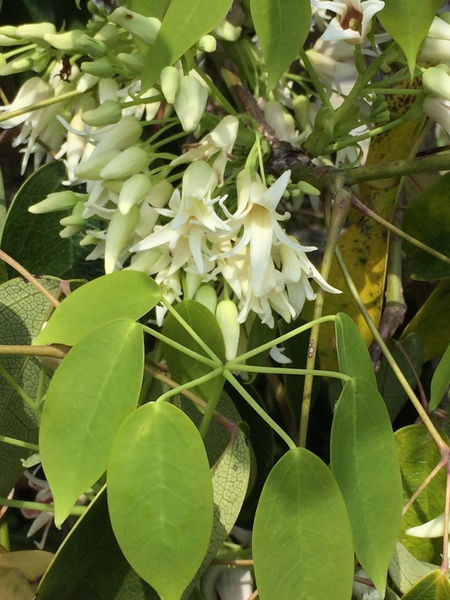
Stauntonia hexaphylla ("Mube")
Japanese name: ムベ (郁子)
Scientific name: Stauntonia hexaphylla
[Overview]
An evergreen woody climber found in evergreen forests and at forest edges.
The leaves are alternate and palmately compound, with 5–7 leaflets.
In young plants there are sometimes only 3 leaflets.
The leaflets are elliptic, 5–10 cm long and 2–4 cm wide, thick, with a glossy upper surface.
On the underside of the leaf, the netlike veins are conspicuous.
The leaf margins are entire.
The leaflet stalks are 1–4 cm long.
There are male and female flowers, both borne in short racemes arising from the leaf axils.
There are 3–7 male flowers per inflorescence, and fewer female flowers.
The flowers have no petals; the conspicuous parts are the 6 sepals, pale cream with pale reddish purple stripes on the inside.
The fruit is an ovoid berry 5–8 cm long that ripens to purple, but unlike Akebi it does not split open when ripe.
The flesh is white and sweet, and like that of Akebi it is edible.
The seeds are black and numerous.
[Uses]
The stems, roots and rind are used as a folk medicine.
[Cultivation]
Propagate from seed, by cuttings, or by layering.
It prefers sun, good drainage and water retention, and moderately moist soil.
For potted plants, water thoroughly when the soil surface dries; for plants in the ground, rainfall is sufficient.
Apply organic fertilizer around the plant as fertilizer in winter.
A single plant will bear fruit, but fruiting is better with two plants.
There are no particular pests or diseases.
Details
Translated from our Japanese encyclopedia. If anything differs, the Japanese page is correct.