
Plant Encyclopedia

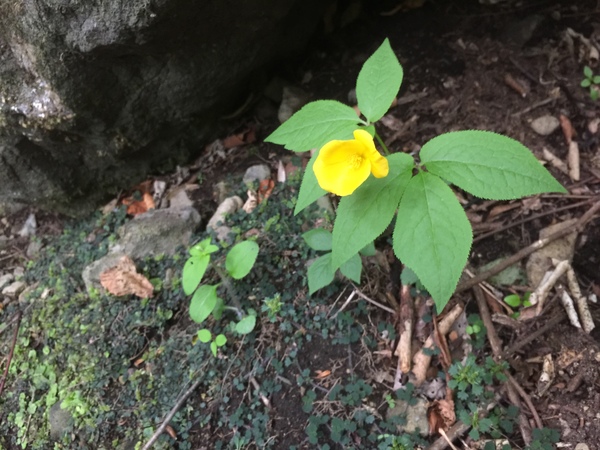
Hylomecon japonica ("Yamabukiso")
Japanese name: ヤマブキソウ (山吹草)
Scientific name: Hylomecon japonica
[Overview]
A perennial 30–50 cm tall, often growing in colonies in deciduous forests.
The rhizome is short and creeping.
When the stem or leaves are damaged, they exude an orange-yellow sap.
There are basal leaves and stem leaves; the basal leaves are odd-pinnately compound with 5–7 leaflets.
The leaflets are broadly ovate to elliptic, 1.5–5 cm long and 1.2–3 cm wide, with cuts and teeth on the margin.
The basal leaves have short stalks.
The stem leaves are alternate near the tip and usually divided into 3 leaflets.
In the upper leaf axils of the stem, 1–2 orange-yellow 4-petaled flowers 3–4 cm across are borne.
The flower stalk is 4–6 cm long.
The fruit is an upright capsule 3–5 cm long and about 0.3 cm across.
In summer to early autumn the above-ground parts die back and the plant goes dormant.
[Uses]
It is poisonous, but it is used medicinally.
[Cultivation]
Propagate from seed or by division.
Sow seed fresh, immediately after harvesting.
From autumn through the flowering season keep it in a sunny place, and after the leaves begin to wither, in a cool place with bright shade.
It dislikes heat and dryness, so keep direct sunlight off the base of the plant.
If planted in the ground, under deciduous trees is best.
It prefers well-drained, fertile, moderately moist soil and dislikes drying out.
For potted plants, during the growing season water thoroughly as soon as the soil surface begins to dry so that it never runs short, and during dormancy water enough to keep it from drying out too much.
For plants in the ground, watering is unnecessary unless it becomes extremely dry.
Apply base fertilizer, and during the growing season apply diluted liquid fertilizer once a week.
Pests include aphids and spider mites.
Details
Translated from our Japanese encyclopedia. If anything differs, the Japanese page is correct.