EVERGREEN

Plant Encyclopedia

Chelidonium majus subsp. asiaticum

Chelidonium majus subsp. asiaticum (greater celandine, "Kusano")

Japanese name: クサノオウ (草黄、草王、瘡王)
Scientific name: Chelidonium majus subsp. asiaticum

Chelidonium majus subsp. asiaticum

[Overview]
A biennial 30–80 cm tall, found in sunny grasslands and along roadsides.
When the stems or leaves are damaged, they exude a yellow sap, which is toxic and causes inflammation if it touches the skin.
The whole plant is tinged powdery white and has curly hairs.
The stem is branched and hollow.
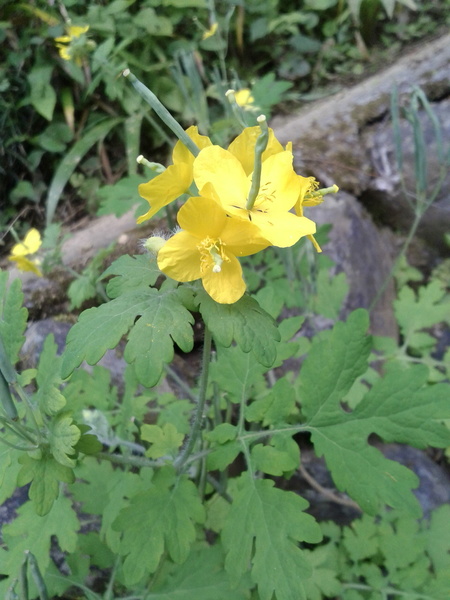
Leaves are alternate, ovate, 7–15 cm long and 5–10 cm wide, and once or twice pinnately divided.
Umbels from the leaf axils bear several flowers.
The flowers are yellow, 4-petaled, about 2 cm across, with many stamens.
The fruit is an erect capsule 3–4 cm long.
The seeds have an appendage (elaiosome) that ants like, and they are carried and dispersed by ants.

[Uses]
Although toxic, the whole plant is used medicinally.

Details

Names
English: greater celandine, nipplewort, swallowwort, tetterwort
Japanese: クサノオウ(草黄、草王、瘡王)
Life form
Winter annual
Habit
Terrestrial
Flowering season
May, June, July
Distribution or origin
Japan (Hokkaido–Kyushu), East Asia
Height
300–800 mm
Leaf shape
Lobed leaf
Leaf arrangement
Alternate
Inflorescence
Umbel
Number of petals
4
Flower color
Yellow
Flower diameter
20
Leaf color
Green
Toxicity
Damaging the stems or leaves releases yellow sap, which causes inflammation if it touches the skin.
Uses
Medicinal
Relationship with animals
Seeds have an appendage liked by ants (elaiosome) and are carried and dispersed by ants.
Japan Flower Trade Code
16720

Translated from our Japanese encyclopedia. If anything differs, the Japanese page is correct.

Sponsored