
Plant Encyclopedia

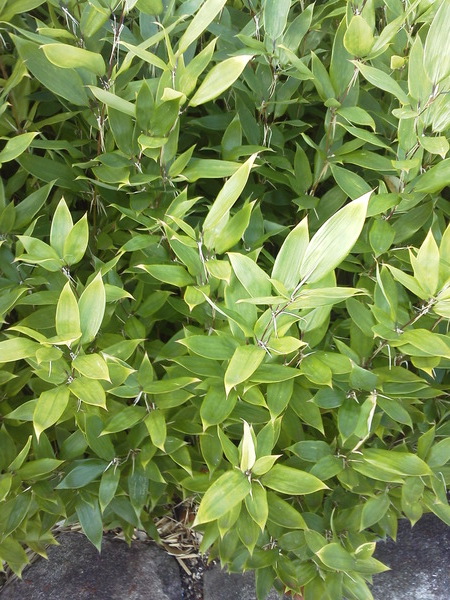
Shibataea kumasaca ("Okamezasa")
Japanese name: オカメザサ (阿亀笹)
Scientific name: Shibataea kumasaca
[Overview]
A bamboo 1–2 m tall, cultivated since ancient times.
It has creeping underground stems.
The culms (stems) rise upright from the nodes of the underground stems, and because the internodes of the underground stems are short, about 1 cm, the culms grow densely.
The internodes of the culm are 5–15 cm, and several very short branches emerge from each node.
The leaves are broadly lanceolate, 6–7 cm long and 1.5–3.5 cm wide, with hairs on the underside.
The spikelets usually consist of 3 florets, are about 2 cm long, and grow in clusters on the branches.
The bamboo shoots appear in June, and the culm sheaths are thin and deciduous.
[History]
It is used for lucky charms, such as those from which okame masks are hung at the Tori-no-ichi fair, or tags and koban (old oval gold coins) are hung at the Toka Ebisu festival.
[Cultivation]
Propagate by division.
It prefers a well-drained, moderately moist place in sun to partial shade.
Rainfall is sufficient unless summer brings a long spell of sunny weather and the soil dries out.
Apply organic fertilizer in winter.
There are no particular pests or diseases.
Details
Translated from our Japanese encyclopedia. If anything differs, the Japanese page is correct.