
Plant Encyclopedia

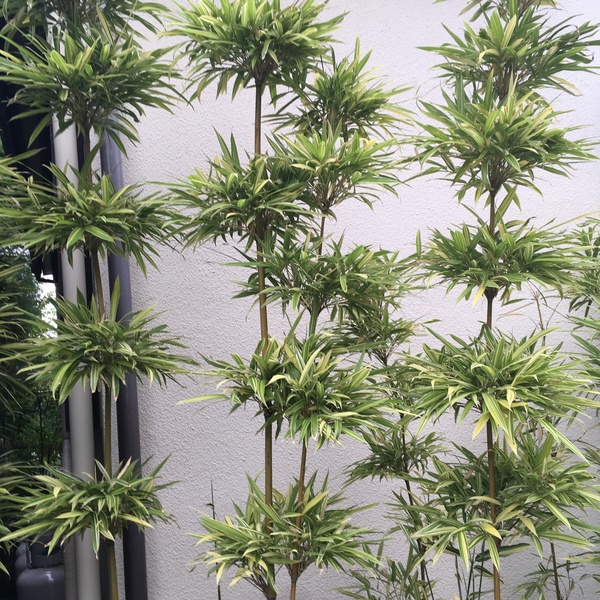
Semiarundinaria fastuosa var. fastuosa (narihira-dake)
Japanese name: ナリヒラダケ (業平竹)
Scientific name: Semiarundinaria fastuosa var. fastuosa
[Overview]
A bamboo 5–10 m tall, often cultivated in gardens and similar places.
It has creeping underground stems.
The culm (stem) rises erect from the nodes of the underground stem and reaches 3–4 cm in diameter; it is green at first but becomes tinged with purplish brown with age.
Branches emerge from the nodes, three at a time in the first year and 7–8 in the second year.
The leaves are narrowly lanceolate, 10–15 cm long and 1.5–2.5 cm wide, hairless, and borne 4–6 at a time at the branch tips.
The spikelets consist of 3–4 florets and grow in clusters of 1–3 on the upper part of the branches.
The bamboo shoots appear in June–July; the culm sheaths are tinged with purple and hairless, and the middle of the base does not separate but hangs for a while before falling off.
[Cultivation]
Propagate by division.
Transplant one month before the bamboo shoots emerge.
It prefers sun to partial shade and fertile, well-drained, moderately moist soil.
Avoid places exposed to strong afternoon sun.
Water thoroughly when the soil surface dries.
Apply organic fertilizer one month before the bamboo shoots emerge and before summer.
There are no particular pests or diseases.
Details
Japanese: ナリヒラダケ(業平竹)、ダイミョウチク(大名竹)
Translated from our Japanese encyclopedia. If anything differs, the Japanese page is correct.