
Plant Encyclopedia

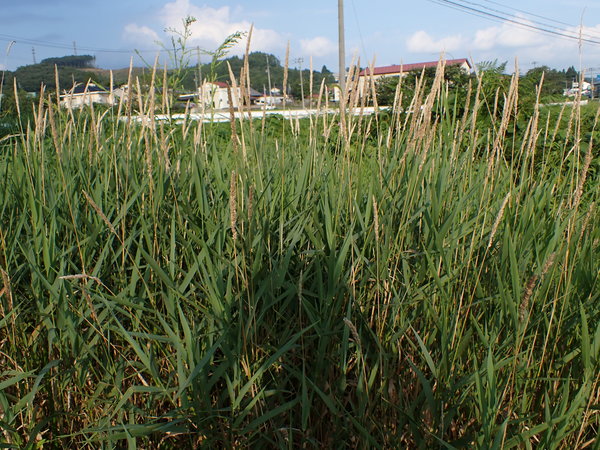
Phalaris arundinacea var. arundinacea (reed canary grass, "Kusayoshi")
Japanese name: クサヨシ (草葭)
Scientific name: Phalaris arundinacea var. arundinacea
[Overview]
A perennial 0.7–1.8 m tall, growing in colonies at the waterside and in wetlands in lowlands.
It spreads by extending rhizomes underground.
The stem (culm) is slender, cylindrical and erect, without hairs.
The leaves are alternate, broadly linear, 20–25 cm long and 0.8–2.5 cm wide, pointed at the tip, tinged with glaucous green, and rough along the margins.
At the base of the leaf there is a small auricle on each side.
The ligule is about 0.3–0.5 cm long, and the leaf sheath is hairless.
The spikelets are densely borne on a slender, branched panicle-like inflorescence 5–25 cm long.
The spikelets are flattened and ovate, 0.4–0.5 cm long, purplish white-green, and consist of 3 florets, but only the third floret develops, and its lemma is hairy.
The glumes are broadly lanceolate and folded in two, with a sharp keel on the back.
[Cultivation]
Propagate by division.
It prefers a sunny, well-ventilated site.
Paddy soil is suitable for planting.
The aboveground parts die back in winter, but keep the water from drying up throughout the year.
From spring to autumn, push slow-release chemical fertilizer or fermented oil cake into the soil.
[Notes]
The Japanese name comes from its resemblance to Yoshi (common reed), being smaller and softer in texture.
Details
Japanese: クサヨシ(草葭)、リードカナリーグラス
Translated from our Japanese encyclopedia. If anything differs, the Japanese page is correct.