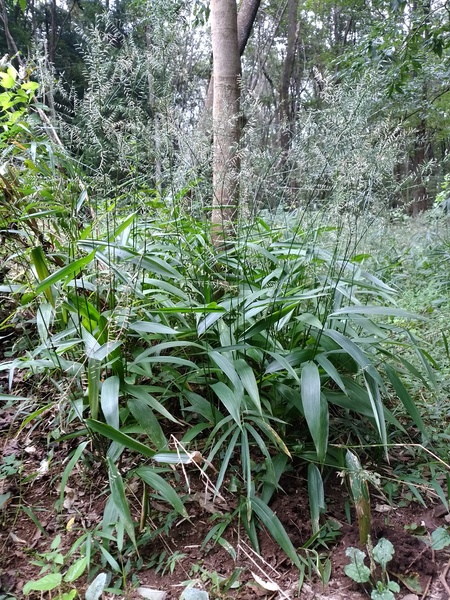
Japanese name: ササクサ(笹草) Scientific name:Lophatherum gracile
[Overview]
A perennial 10–40 cm tall, found in forests in warm regions.
It has a short rhizome.
The culm (stem) is slender, hard and erect.
The leaves are simple and alternate, broadly lanceolate, 10–30 cm long and 2–5 cm wide, with the longitudinal veins connected by transverse veinlets in a grid pattern.
Between the base of the leaf and the leaf sheath there is a short petiole-like part.
A conical flower spike 10–30 cm long is borne at the stem tip, with sparsely arranged branches.
The branches bear spikelets sparsely.
The spikelets are cylindrical-lanceolate, 7–8 mm long, not swollen on the back, and consist of several florets, but only the lowest floret is fertile, and the other florets are sterile and consist only of the lemma.
The awns of the sterile florets have small downward-pointing prickles, and the seeds are dispersed by attaching to clothing and animals by means of these awns.
[Notes]
The name compares the leaves to the leaves of sasa (bamboo grass).