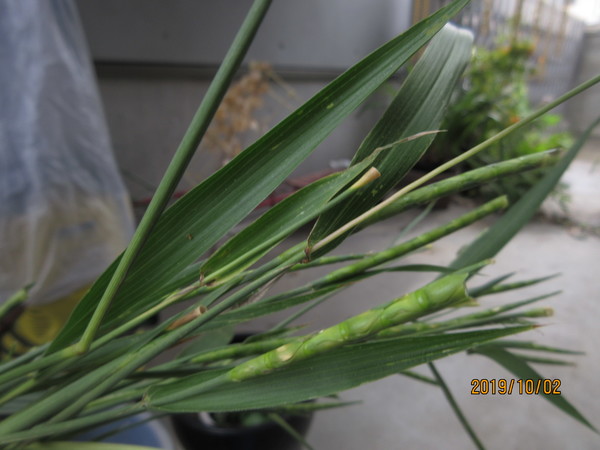
Japanese name: ウシノシッペイ(牛の竹篦) Scientific name:Hemarthria sibirica
[Overview]
A perennial about 1 m tall, found in sunny, wet lowlands.
It extends underground stems and often grows in colonies.
The stem is erect from almost the base, rather stiff, hairless and smooth, and branches in the upper part.
The leaves are linear, 20–30 cm long and 0.3–0.7 cm wide, with hairs on the margins of the leaf sheaths.
A raceme (inflorescence) 5–8 cm long appears at the stem tip or from the leaf axils in the upper part of the stem.
The raceme has many nodes and is a slender cylinder with a pointed tip.
The axis is thick, the internodes bearing the spikelets are 0.4–0.6 cm, and each node produces a stalked spikelet and a sessile spikelet, which lie close against the axis.
The spikelets are lanceolate and consist of 2 florets, but the first floret is reduced.
The upper part of the first glume of the sessile spikelet narrows gradually.
[Notes]
The Japanese name likens the long, slender spike to a long bamboo pole used for driving cattle.