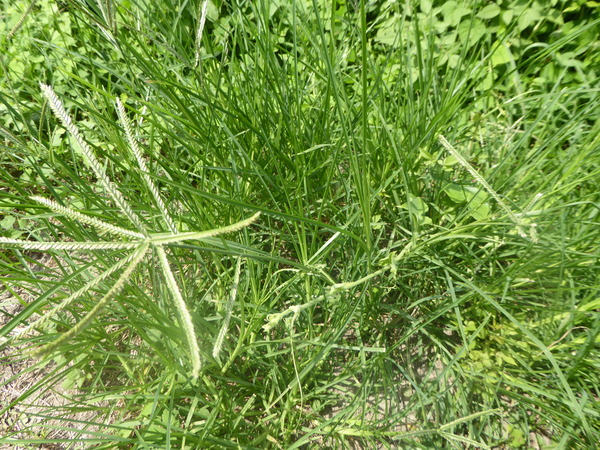
Japanese name: オヒシバ(雄日芝) Scientific name:Eleusine indica
[Overview]
An annual 15–80 cm tall, found on embankments, roadsides, vacant lots and similar places.
The culm (stem) is slightly flattened and smooth, forms a clump, and spreads along the ground at the base before rising upright.
The leaves are linear, 15–40 cm long and 0.3–0.7 cm wide, folded in two along the midrib, with long hairs on the inner side at the base.
The leaf base forms a flattened sheath whose back is keeled.
From the stem tip, 2–7 inflorescences emerge radially; each is a flattened rod 7–15 cm long and 0.3–0.4 cm wide.
Ovate green spikelets are densely arranged in two rows on the underside of the axis of the inflorescence; each spikelet consists of 4–5 florets and has no awns.
[Notes]
The Japanese name was given because it gives a sturdier impression than Mehishiba.