
Plant Encyclopedia

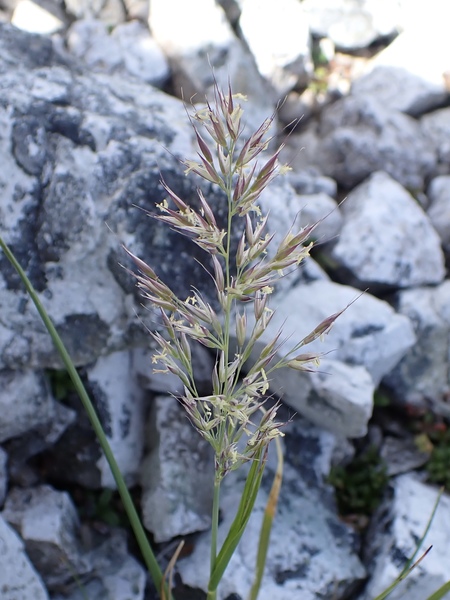
Calamagrostis sesquiflora subsp. urelytra ("Miyamanogariyasu")
Japanese name: ミヤマノガリヤス
Scientific name: Calamagrostis sesquiflora subsp. urelytra
[Overview]
A perennial 10–40 cm tall, found in alpine grasslands and wild lands.
The stems grow densely and stand upright.
The leaves are linear; those at the base of the stem reach as much as 30 cm long, while the stem leaves are 3–10 cm long and 0.2–0.5 cm wide, hairless and rough.
An upright panicle 5–10 cm long is produced at the stem tip, densely bearing many spikelets.
The inflorescence branches are short, and the inflorescence is cylindrical except during flowering.
The spikelets are slightly flattened, lanceolate to narrowly ovate, 0.5–1 cm long, pale green or often tinged pale purple, and consist of 1 floret.
The spikelets have short stalks.
At the base of the floret are hairs 1/3–1/5 the length of the lemma.
There are 2 glumes, about the same length as the spikelet, and slightly rough.
The lemma is shorter than the glumes, and its lateral veins project to form 5 teeth.
It has a long, rather thick awn, which bends inward at an angle.
Details
Translated from our Japanese encyclopedia. If anything differs, the Japanese page is correct.