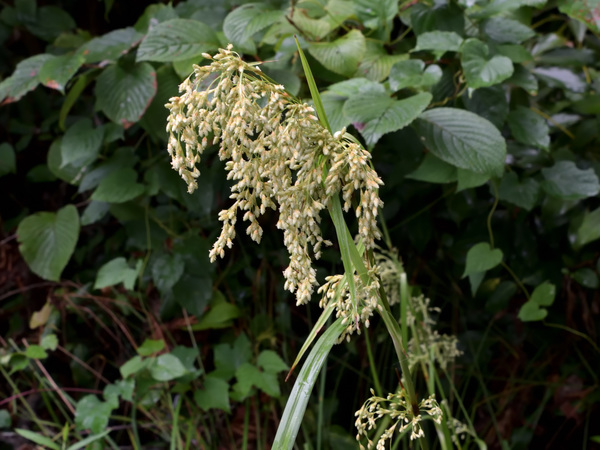
Japanese name: アブラガヤ(油茅) Scientific name:Scirpus wichurae
[Overview]
A perennial 70–150 cm tall, growing in wetlands.
It has a short rhizome.
The stem is bluntly triangular in cross section, hard, and has 5–8 nodes.
The leaves are basal and alternate, linear, 0.5–1.5 cm wide; the sheaths of the stem leaves wrap tightly around the stem in a tube.
At the stem tip it produces a compound corymbose inflorescence made up of 1–4 partial inflorescences, bearing many spikelets.
There are linear, leaf-like involucral bracts.
The spikelets are borne singly or in bundles of 2–3 at the tips of stalks; they are elliptical, reddish brown, 4–8 mm long and 2.5–4 mm wide.
The scales of the spikelets are ovate-elliptical, 2–2.5 mm long and 1 mm wide.
There are 6 bristle-like perianth segments, which are curled into threads and rough in an upward direction.
The fruit is pale reddish brown and elliptical with 3 ridges, 0.8–1.3 mm long; the bristle-like perianth segments are longer than the fruit and protrude from between the scales.
[Notes]
The Japanese name comes from the oily color of the spikes and their slight oily smell.