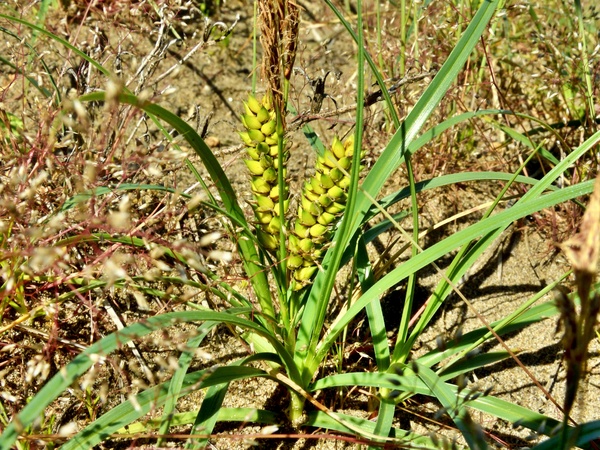
Japanese name: コウボウシバ(弘法芝) Scientific name:Carex pumila
[Overview]
A perennial 10–20 cm tall, growing on sandy seashores.
It has long, horizontally extending rhizomes and grows sparsely.
The rhizomes bear long stolons.
The leaves are linear, 0.2–0.4 cm wide, and leathery.
The leaf sheaths at the base of the flowering stem have no blade and are dark purplish brown.
Spikelets are borne at the tip of the flowering stem; the 2–4 spikelets at the top are male and linear, 2–3 cm long.
Below them, 1–2 female spikelets grow in a cluster; they are oblong to cylindrical, 1.5–3 cm long, short-stalked, and nearly erect.
Part of the scales of the female spikelets is tinged with red.
The perigynium is 0.6–0.8 cm long, and the beak at its upper end narrows gradually.
[Cultivation]
Propagate from seed or by division.
The seeds need light to germinate, so cover them with only a very thin layer of soil.
It grows in full sun and prefers well-drained, dry soil.
Rainfall is sufficient for watering.
If basal fertilizer is applied, no further fertilizing is particularly necessary.
There are no particular pests or diseases.