
Plant Encyclopedia

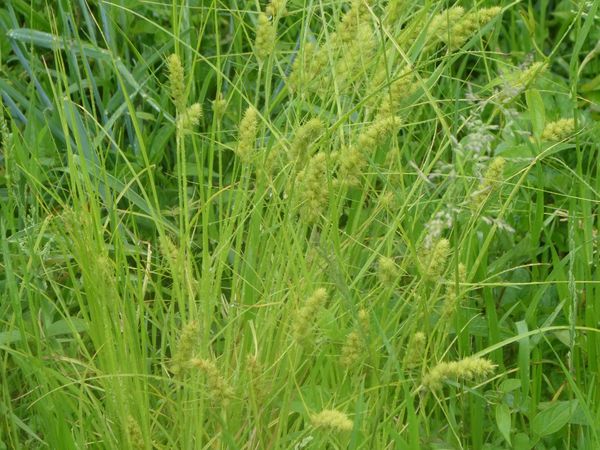
Carex neurocarpa ("Mikoshigaya")
Japanese name: ミコシガヤ (神輿茅)
Scientific name: Carex neurocarpa
[Overview]
A perennial 30–60 cm tall, found in damp grassland on lowlands, riverbeds, wetlands, and similar places.
The rhizome is short and does not produce stolons.
The stem is slightly three-angled and smooth.
The leaves are linear, 0.2–0.3 cm wide.
A cylindrical inflorescence 3–6 cm long is borne at the stem tip, densely set with spikelets.
The spikelets have male flowers in the upper part and female flowers in the lower part, and are tinged slightly reddish brown.
At the base of each spikelet there is a leaf-like bract, and the lower 2–3 are longer than the inflorescence.
The perigynia are ovate, 0.4 cm long, with many veins and membranous; only the margin of the upper half has a broad wing, and the top forms a beak.
[Cultivation]
Propagate from seed or by division.
The seeds need light to germinate, so cover them with only a very thin layer of soil.
It prefers a place with good sun, good drainage, and good water retention.
Avoid places exposed to strong afternoon sun or places that dry out.
In a suitable location, rainfall is sufficient.
If a base fertilizer is applied, no further fertilizing is particularly necessary.
There are no particular pests or diseases.
Details
Translated from our Japanese encyclopedia. If anything differs, the Japanese page is correct.