
Plant Encyclopedia

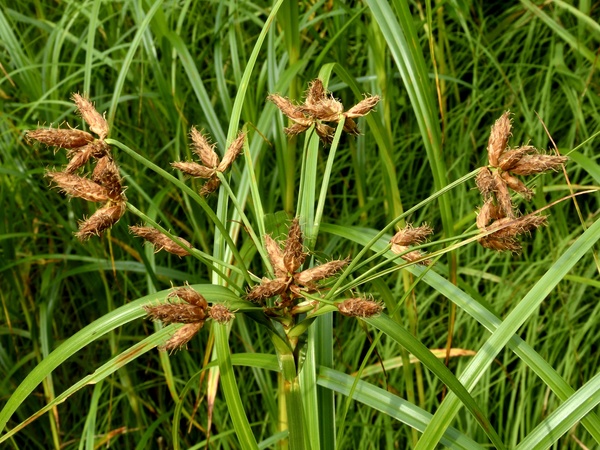
Bolboschoenus fluviatilis subsp. yagara ("Ukiyagara")
Japanese name: ウキヤガラ (浮矢幹、浮矢柄)
Scientific name: Bolboschoenus fluviatilis subsp. yagara
[Overview]
A perennial 1–1.5 m tall, growing in shallow water of ponds, marshes and rivers, and in wetlands.
It often grows in colonies.
It has long, creeping underground stems in the mud at the bottom of the water, bearing several round tubers 3–4 cm across in a string of beads.
1–2 stems stand upright from the tubers, and the stem is triangular in cross section.
The stem has several nodes, and the leaves are attached on the lower part.
The leaves are linear, 15–60 cm long and 0.5–1 cm wide.
At the stem tip, 3–8 branches bearing spikelets are produced in a corymb-like arrangement, with 2–4 long leaf-like bracts at the base.
The spikelets are brown, oblong, about 1–2 cm long and 0.6–0.8 cm wide.
The scales of the spikelet are ovate with a tip split in two, and an awn emerges from between them.
There are 3 stamens, and the style is 3-branched.
There are 6 bristle-like tepals, shorter than the fruit and persistent.
The fruit is about 0.4 cm long, nearly a regular three-sided prism in shape, and glossy blackish brown.
[Uses]
The tubers are used medicinally.
[Cultivation]
Propagate by division.
Plant it in a sunny place where the base of the plant is always submerged in water.
[Notes]
The Japanese name comes from the thick stem being likened to an arrow shaft, and from the fact that the stems float on water when they wither.
Details
Translated from our Japanese encyclopedia. If anything differs, the Japanese page is correct.