
Plant Encyclopedia

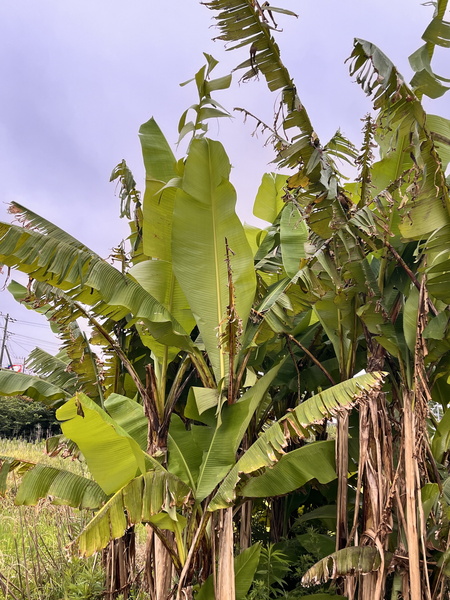
Musa basjoo (Japanese banana, "Basho")
Japanese name: バショウ (芭蕉)
Scientific name: Musa basjoo
[Overview]
An evergreen perennial about 5 m tall and 20 cm across.
What looks like a trunk is formed by the overlapping leaf sheaths at the bases of the leaf stalks, and is called a pseudostem.
The leaves unfold as the plant develops and are elliptic, 150–200 cm long and 40–50 cm wide.
There are male flowers and female flowers.
The inflorescence appears at the tip of the pseudostem; it is an elliptic-conical shape of overlapping bracts and usually hangs down.
The bracts are yellowish brown and ovate, and they peel back one at a time from the base, revealing about 25 female flowers in two overlapping rows.
The female flowers are 6–7 cm long and yellowish white.
Only male flowers grow at the tip of the inflorescence.
The fruit is banana-like, 6 cm long, and hardly any seeds form.
The plant dies after fruiting, but it is renewed by offsets that emerge from the base.
[Uses]
A cloth called basho-fu is woven from the fibers of the leaf sheaths.
The whole plant is used medicinally.
[Cultivation]
Propagate by dividing suckers.
It can be grown outdoors in the Kanto region and south.
It prefers sunny, well-drained, moist, fertile soil.
Water thoroughly when the soil surface dries, and take care that it does not run short of water in summer.
Keep it on the dry side in winter.
It is weak against dryness, and too much moisture can also cause root rot.
From spring to autumn, apply a slow-release fertilizer with equal amounts of the three components.
Pests include aphids and spider mites.
Details
Japanese: バショウ(芭蕉)
Translated from our Japanese encyclopedia. If anything differs, the Japanese page is correct.