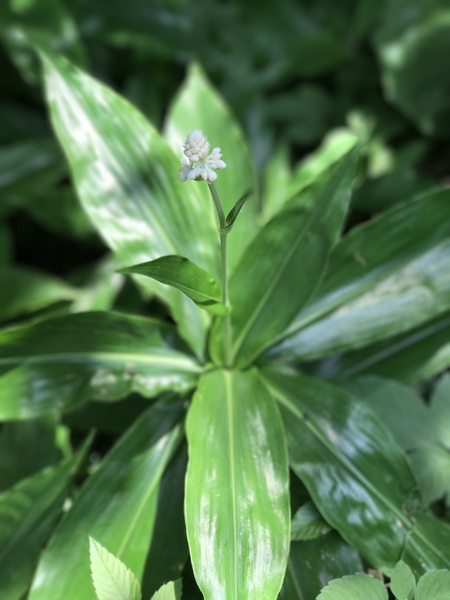
Japanese name: ヤブミョウガ(藪茗荷) Scientific name:Pollia japonica
[Overview]
A perennial 50–100 cm tall, growing in colonies in slightly damp, partially shaded places in forests in warm regions.
It spreads by long-extending underground stems.
The stem is erect.
The leaves are simple and densely alternate around the middle of the stem, narrowly oblong-elliptical, 20–30 cm long and 3–6 cm wide.
The upper surface of the leaf is rough, and the underside has fine hairs.
The leaf base clasps the stem.
A conical cyme 20–30 cm long emerges at the stem tip.
The flowers are white, 7–10 mm across, and each flower withers in a day.
The fruit is spherical, 5 mm across, and ripens to indigo blue.
[Uses]
The whole plant is used medicinally.
[Notes]
The Japanese name derives from its resemblance in appearance to Myoga and its growing in thickets.