
Plant Encyclopedia

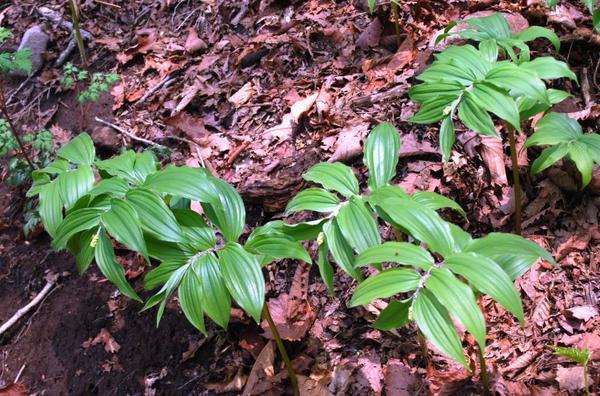
Maianthemum japonicum ("Yukizasa")
Japanese name: ユキザサ (雪笹)
Scientific name: Maianthemum japonicum
[Overview]
A perennial 20–70 cm tall, found in deciduous forests in the mountains.
It has creeping rhizomes, whose thickened parts occur in a series at intervals.
The upper part of the stem leans over.
Several leaves are produced; they are alternate, simple, oblong, 6–15 cm long, hairy on both sides, with conspicuous longitudinal veins.
A panicle at the stem tip bears many small white flowers, and the inflorescence and flower stalks are hairy.
There are 6 tepals, which open flat.
There are also 6 stamens.
The fruit is a spherical berry about 5 mm in diameter; at first it is pale green with purplish brown spots, but turns red when ripe.
[Uses]
The rhizome is used externally as a folk remedy.
[Cultivation]
Propagate by division.
It prefers well-drained, moisture-retentive soil that is moderately moist.
It is best kept in sun from autumn to spring and in partial shade in summer; in the ground, it is best planted under deciduous trees or the like.
Take care not to let it dry out; for potted plants, water thoroughly from spring to autumn when the soil surface dries, and do not let the soil dry out completely even during dormancy.
For plants in the ground, rainfall is sufficient unless sunny weather continues in summer and the soil dries out.
In spring, apply slow-release fertilizer placed on the soil.
Pests include aphids and slugs.
[Notes]
The Japanese name compares the leaves to sasa (bamboo grass) and the flowers to snow.
Details
Translated from our Japanese encyclopedia. If anything differs, the Japanese page is correct.