
Plant Encyclopedia

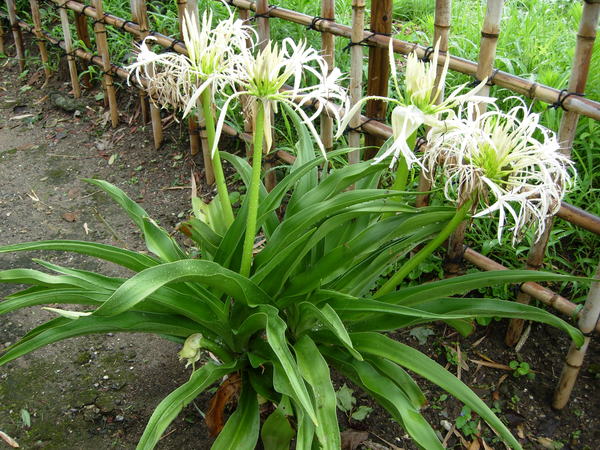
Crinum asiaticum var. japonicum (poison bulb, "Hamaomoto")
Japanese name: ハマオモト (浜万年青)
Scientific name: Crinum asiaticum var. japonicum
[Overview]
An evergreen perennial that grows on seacoasts.
It has a cylindrical bulb 30–50 cm long and 3–7 cm in diameter.
The leaves are basal, strap-shaped, 30–70 cm long and 4–10 cm wide, somewhat fleshy and glossy.
A sturdy, thick flower stalk 50–80 cm tall bears an umbel at its tip.
At the base of the inflorescence are 2 white, membranous, linear-oblong bracts 6–10 cm long.
The flowers are white, with 6 tepals whose lower parts form a narrow tube 4–6 cm long.
The tepals are linear, 5–8.5 cm long and 0.5–0.8 cm wide, and curve backward.
There are 6 stamens, with the anthers attached in a T shape.
The flowers are fragrant, especially strongly at night.
The fruit is a spherical capsule 2–4 cm long, which splits irregularly when ripe.
The seeds are spherical, 2–3 cm in diameter; the seed coat is grayish-white and cork-like, and the inside is spongy, so the seeds float on seawater and are dispersed that way.
[Uses]
The bulb is poisonous but is used medicinally.
[Cultivation]
Propagate from seed.
It can overwinter outdoors in areas without frost.
It prefers sunny, well-drained soil, and potted plants need a large deep pot of No. 10 or larger.
For potted plants, water thoroughly when the soil dries from spring to autumn, and keep on the dry side in winter.
For plants in the ground, rainfall is sufficient.
Place slow-release fertilizer on the soil in spring and autumn.
Pests and diseases include virus disease and the Hamaomoto-yoto moth.
[Notes]
The name was given because it grows on the seacoast and its leaves resemble those of Omoto.
Details
Japanese: ハマオモト(浜万年青)、ハマユウ(浜木綿)
Translated from our Japanese encyclopedia. If anything differs, the Japanese page is correct.