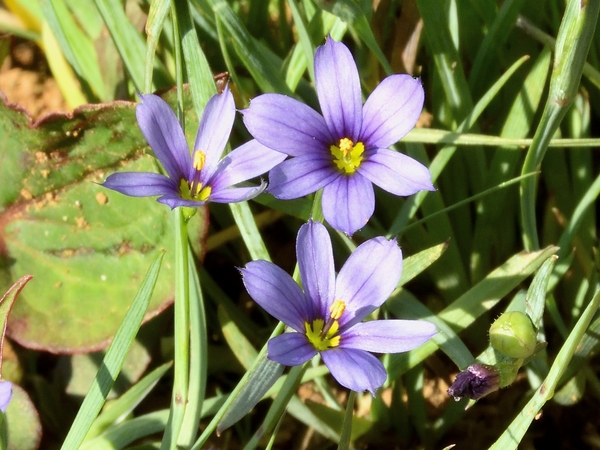
Japanese name: ルリニワゼキショウ(瑠璃庭石菖) Scientific name:Sisyrinchium angustifolium
[Overview]
A perennial 15–50 cm tall, found in sunny places such as roadsides and lawns.
It has a short rhizome.
The stem branches.
The leaves are linear, 0.2–0.6 cm wide.
The inflorescence does not branch and has spatulate bracts with pointed tips, 2–3 cm long and 0.3–0.4 mm wide.
The flowers have 6 petals and are 0.8–1.2 cm across, pale blue to violet, and the tips of the perianth usually taper to an awn-like point.
The base of the flower is yellow.
There are 3 stamens, which are almost completely fused together.
The fruit is a spherical capsule about 0.5 cm across, black to dark brown.
[Cultivation]
Propagate from seed or by division.
It prefers a sunny, well-drained, moisture-retentive and well-ventilated location.
For potted plants, water thoroughly when the soil surface dries; for plants in the ground, rainfall is sufficient unless sunny weather continues and the soil becomes very dry.
Fertilizer is not particularly necessary if a base fertilizer is applied.
There are no particular pests or diseases.