
Plant Encyclopedia

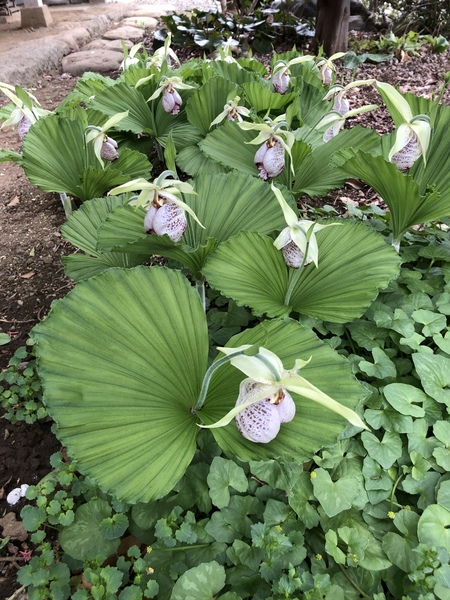
Cypripedium japonicum var. japonicum (Japanese cypripedium, "Kumagaiso")
Japanese name: クマガイソウ (熊谷草)
Scientific name: Cypripedium japonicum var. japonicum
[Overview]
A perennial 20–40 cm tall, found on forest floors, especially in sugi (Japanese cedar) forests and bamboo groves.
It is a terrestrial orchid.
It spreads its rhizomes sideways and grows in colonies.
The stem is hairy.
Two leaves grow alternately, but because they are close together they look opposite.
The leaves are fan-shaped to round, 10–20 cm across, with many veins extending radially and with longitudinal wrinkles.
The flowers are borne singly at the stem tip, large at 10 cm across, and bloom facing sideways.
The sepals and lateral petals are 4–5 cm long and pale yellowish green.
The inner side of the lateral petals has brown spots.
The lip forms a large pouch and is cream-colored with reddish purple veins.
[Cultivation]
Propagate by division.
This species has long internodes on the rhizome, so take care not to break it, and plant it with 4 nodes.
For potted plants, a large pot or planter is best.
It prefers well-drained soil, so for potted plants it is good to use soil made for mountain wildflowers.
Grow it in a place that is in partial shade throughout the year.
Exposure to direct sunlight in summer causes leaf scorch, which weakens the plant and may keep it from flowering the following year.
It is best to move it to cool shade in summer.
Take care to protect it from freezing and frost in winter.
For potted plants, water thoroughly when the soil surface has dried, and water somewhat sparingly in midsummer.
In winter as well, water sparingly, just enough to keep the soil slightly moist.
The plant declines if it becomes either too dry or too wet.
For plants in the ground, rainfall is sufficient.
In spring and autumn, apply liquid fertilizer diluted 1000 times twice a month.
Pests and diseases include slugs and red mites.
[Notes]
The Japanese name likens the pouch-shaped lip to the horo (a cloth cape worn on the back of a warrior) carried by Kumagai Naozane.
Details
Japanese: クマガイソウ(熊谷草)、クマガエソウ(熊谷草)
Translated from our Japanese encyclopedia. If anything differs, the Japanese page is correct.