
Plant Encyclopedia

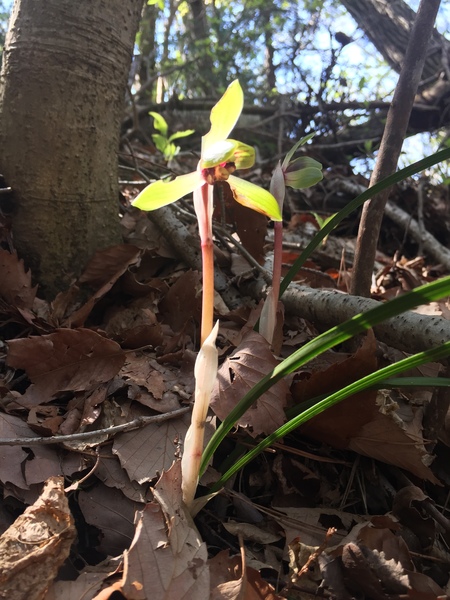
Cymbidium goeringii var. goeringii (noble orchid, "Shunran")
Japanese name: シュンラン (春蘭)
Scientific name: Cymbidium goeringii var. goeringii
[Overview]
An evergreen perennial found in slightly dry forests.
It is a terrestrial orchid.
It has a corm, and the roots are thick and cord-like.
The leaves grow in clusters, are long, narrow and linear, 20–35 cm long and 0.6–1 cm wide, curve in an arc, and have minute serrations on the margin.
The leaf base forms a sheath.
A fleshy flower stalk 10–25 cm tall emerges, bearing 1 flower (rarely 2) at the tip.
The flower stalk is enclosed by several membranous sheath-like leaves.
The bract is lanceolate, 3–4 cm long.
The flowers are yellowish green, and the sepals and lateral petals are almost the same in shape and color.
The sepals are oblanceolate, 3–3.5 cm long and 0.7–1 cm wide, and somewhat fleshy.
The lip is 3-lobed, and the middle lobe is white with reddish purple spots and curls back like a tongue.
The fruit is an oblong capsule.
[Uses]
The flowers and flower stalks are used as wild vegetables.
The roots are used as a folk medicine.
[Cultivation]
Propagate by division.
Grow it in an unglazed clay pot, using soil with good aeration and drainage.
Using soil made for orchids is the easy way.
Use a pot with legs, or place it on a shelf, so that air reaches the bottom of the pot.
It prefers airy partial shade, so when planting in the ground, plant it under a tree.
Take care not to let it become too wet when watering; for potted plants, water thoroughly when the soil dries from spring to autumn, and keep it on the dry side in winter.
Once flower buds appear, avoid getting water on them.
In spring and autumn, give liquid fertilizer about once a month, or place slow-release fertilizer on the soil.
Pests and diseases include virus diseases, aphids and spider mites.
Details
Japanese: シュンラン(春蘭)、ホクロ、ジジババ
Translated from our Japanese encyclopedia. If anything differs, the Japanese page is correct.