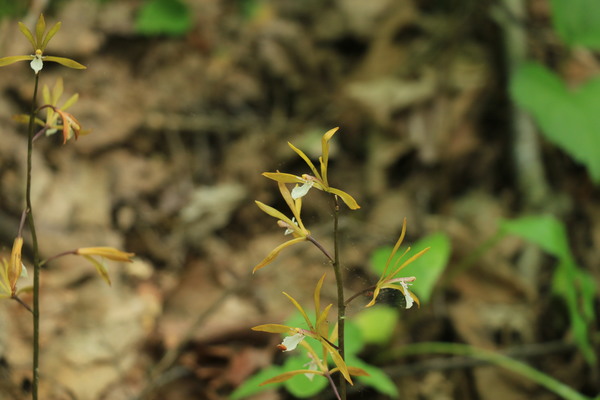
Japanese name: トケンラン(杜鵑蘭) Scientific name:Cremastra unguiculata
[Overview]
A perennial growing in deciduous forests.
It has spherical pseudobulbs underground, connected by slender rhizomes.
Two leaves emerge from each new pseudobulb.
The leaves are oblong, 10–12 cm long and 3–5 cm wide, with pointed tips, and often have purple spots.
The leaves overwinter and wither in summer.
An erect flower stalk 30–40 cm tall emerges from the pseudobulb and bears a raceme, with several flowers blooming facing sideways.
The sepals are linear-oblanceolate, 1.8–2 cm long, and the lateral petals are linear; both are yellowish brown with purple spots and have pointed tips.
The lip is white with purple spots and 3-lobed, clasping the lower part of the column.
The lateral lobes of the lip are small, while the middle lobe is obovate and large, with a wavy margin.
[Notes]
The Japanese name likens the spots on the flowers to the spots on the belly of the hototogisu (cuckoo).