
Plant Encyclopedia

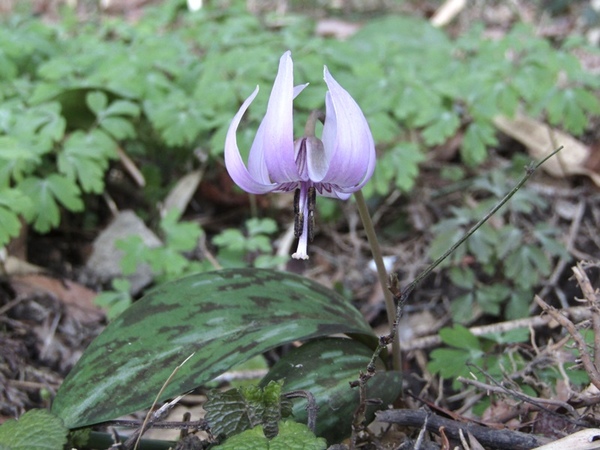
Erythronium japonicum (Asian fawnlily, "Katakuri")
Japanese name: カタクリ (片栗)
Scientific name: Erythronium japonicum
[Overview]
A perennial 10–20 cm tall that often grows in colonies in places such as deciduous forests.
It is common north of the Chubu region and rare in Shikoku and Kyushu.
It is one of the typical spring ephemerals: by the time the surrounding trees and grasses leaf out, it has set fruit, its aboveground parts have died back, and its activity is over.
Underground it has an oblong bulb 5–6 cm long.
The bulb sinks deep into the ground (up to 30 cm) through the pulling action of its roots.
After germination, the first-year leaf is thread-like.
After that, only one elliptic leaf appears until the plant reaches flowering size.
A flowering plant has two basal leaves.
The leaves are oblong to ovate, 6–12 cm long, with dark purple blotches.
The leaves have long petioles, but because the petioles are buried underground, only the blades appear above ground.
The flowers are borne singly at the tip of a flower stalk that grows from the bulb, and open facing downward in a nodding position.
The flowers are reddish purple with 6 petals; the tepals are lanceolate, 4–5 cm long, and strongly reflexed.
There are nectaries near the base of the tepals, and Gifu-cho butterflies visit to drink the nectar.
Above the nectaries there is a dark purple W-shaped blotch, thought to be a marker indicating the presence of nectar (a nectar guide).
There are 6 stamens, and the anthers are dark purple.
The fruit is a capsule, and at the fruiting stage the flower stalk grows to 30 cm and falls to the ground.
The seeds have an appendage (elaiosome) that ants like, and they are carried and dispersed by ants.
[Uses]
Starch (katakuri-ko) was formerly obtained from the bulb.
The katakuri-ko sold today is potato starch.
The young leaves are boiled and eaten as a wild vegetable.
[Cultivation]
Propagate from seed, but it takes 7–8 years to flower.
Collect the seeds when the fruits ripen in June, and sow them immediately.
It cannot be propagated by bulbs because its ability to form offset bulbs is weak.
From winter through the flowering period, keep it in a sunny place; after the leaves begin to wither, keep it in a cool place in bright shade.
When planting in the ground, under deciduous trees is good.
It prefers soil that is rich in organic matter and well drained, and because the bulb sinks deep, plant it in a deep pot.
For potted plants, from sprouting through the period when leaves are present, water thoroughly when the soil surface dries; after the leaves fall, water just enough that the soil does not dry out completely.
For plants in the ground, no watering is particularly necessary.
In autumn, place slow-release fertilizer on the soil, and from autumn until the leaves wither, apply diluted liquid fertilizer once a week.
Rust is a disease that can occur.
[Notes]
The Japanese name is said to derive from the old name "katakago", which became "katakoyuri" and then changed to "katakuri"; the kanji 片栗 is said to be ateji (characters chosen for their sound).
Details
Japanese: カタクリ(片栗)、カタカゴ(堅香子、傾籠)
Translated from our Japanese encyclopedia. If anything differs, the Japanese page is correct.