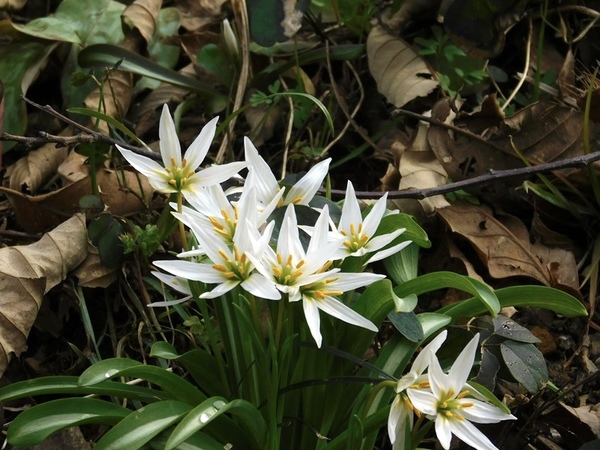
Japanese name: ヒロハノアマナ(広葉甘菜) Scientific name:Amana erythronioides
[Overview]
A perennial 10–20 cm tall, growing in grassland and open woodland.
It has an ovate bulb underground.
There are 2 alternate leaves, linear, 10–15 cm long and 1–2 cm wide, wider than those of Amana, with a white line in the center.
The leaf bases are underground, so the leaves appear to grow directly from the root.
The flower stalk usually has 3 bracts and bears a single flower at its tip.
The flower is white with 6 petals; the tepals are slender, with purple stripes on the outside.
The flower opens when it is in the sun.
The fruit is a capsule about 1 cm long.
[Uses]
The bulb is sweet and is used medicinally and as food.