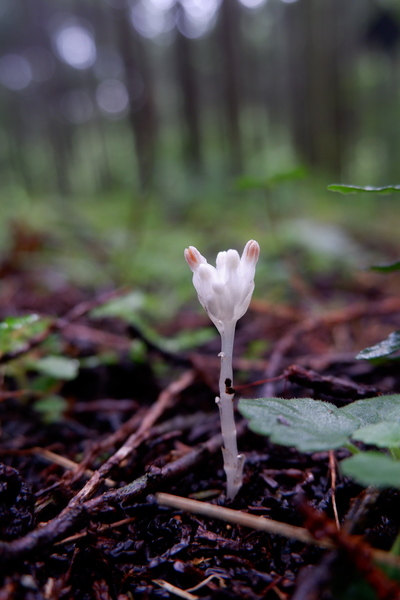
Japanese name: ヒナノシャクジョウ(雛錫杖) Scientific name:Burmannia championii
[Overview]
A small, delicate perennial 3–15 cm tall, a mycoheterotrophic plant growing among damp fallen leaves in forests.
It has no chlorophyll, and the whole plant is white to pale yellow.
It has a rhizome swollen into a ball, with many fibrous roots.
There is only one erect stem, which does not branch.
The leaves are sparsely alternate and scale-like, lanceolate to ovate, 1.5–4 mm long.
2–10 flowers bloom in a somewhat head-like cluster at the stem tip, and the flowers have no stalks.
The flowers are white and 6–7.5 mm long; the tepals are fused at the base into a tube, and the floral tube has no wings.
The outer tepals are triangular and yellow on the inside.
The fruit is an obovate-round capsule.
[Notes]
The name comes from its small size and its shape resembling a shakujo (a monk's staff).