
Plant Encyclopedia

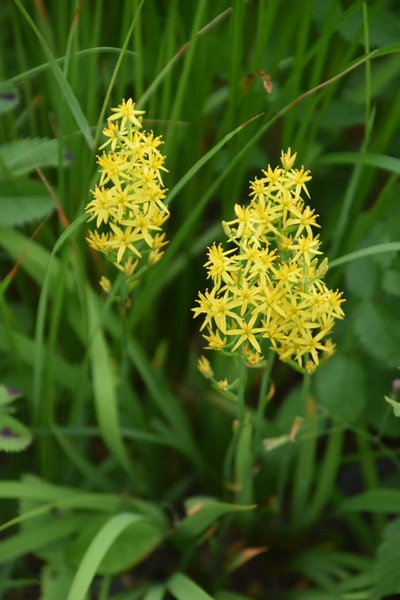
Narthecium asiaticum ("Kinkoka")
Japanese name: キンコウカ (金黄花、金光花)
Scientific name: Narthecium asiaticum
[Overview]
A perennial 20–50 cm tall, found in mountain wetlands and often growing in colonies.
It has slender creeping rhizomes.
The leaves are of two kinds: basal leaves and several alternate leaves on the stem.
The basal leaves are slender and sword-shaped, 8–35 cm long; the upper surfaces are folded together along the midvein so that only the back faces outward, making them unifacial leaves.
The basal leaves are borne in two rows, and their bases overlap like a hakama (pleated skirt).
A raceme 4–12 cm long at the tip of the flower stalk bears many flowers.
The flowers are yellow with 6 tepals, open flat, and are fused at the base.
The tepals do not fall after flowering but remain and turn green.
There are 6 stamens, slightly shorter than the tepals, and the filaments are densely hairy.
The fruit is a lanceolate capsule, and the seeds have thread-like wings (tails) at both ends.
[Cultivation]
Propagate from seed or by division.
It prefers soil that is well drained and retains water; a mixture of Kanuma soil and Kiryu sand, or soil for mountain wildflowers, is suitable.
From autumn to spring, place it in a sunny, well-ventilated spot; from early summer to summer, place it in a cool, airy place in partial shade.
So that it never dries out, water daily from spring to autumn, and water enough during dormancy to keep it from drying out.
Little fertilizer is needed; give diluted liquid fertilizer in spring and autumn, and make sure no fertilizer remains in midsummer.
There are no particular pests or diseases.
[Notes]
The name comes from the color of the flowers.
Details
Translated from our Japanese encyclopedia. If anything differs, the Japanese page is correct.