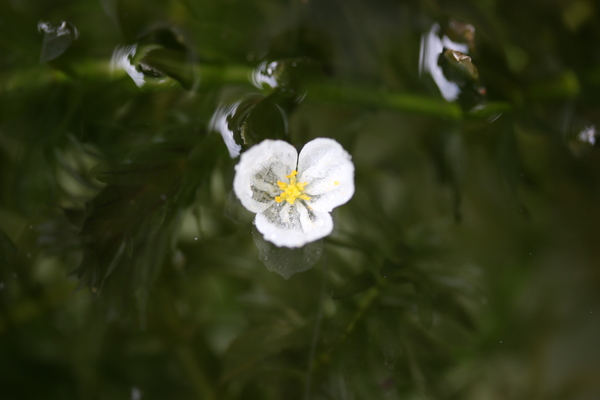
Japanese name: オオカナダモ(大加奈陀藻) Scientific name:Egeria densa
[Overview]
A submerged evergreen perennial found in lakes, reservoirs, canals and similar places, often growing in colonies.
The stem is slender and produces fibrous roots from the nodes, sometimes extending to more than 2 m in length.
The leaves are simple, in whorls of 3–6, linear, 1–4 cm long and 0.2–0.5 cm wide, with pointed tips and fine serrations on the margins.
It is dioecious.
The flowers are white, 3-petaled, 1–2 cm across, and bloom above the water surface; the male flowers are borne 2–4 in a spathe arising from the leaf axil, and the female flowers singly in a spathe arising from the leaf axil.
The anthers are yellow.
Each flower withers in a day.
[History]
It is said to have been introduced in the mid-Taisho period as experimental material for plant physiology and other purposes, and then escaped and spread; only male plants are found in Japan, and they reproduce vegetatively.