
Plant Encyclopedia

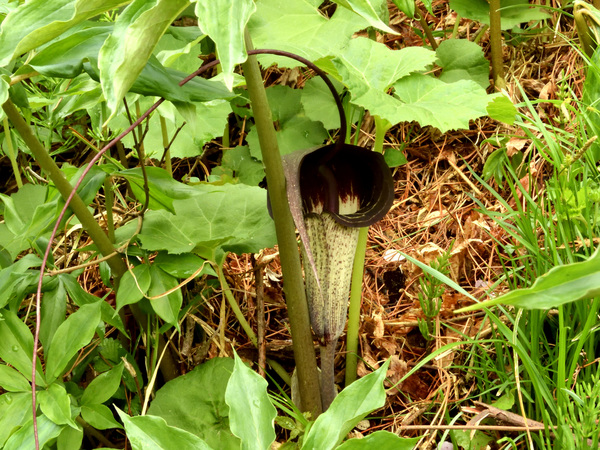
Arisaema thunbergii subsp. urashima ("Urashimaso")
Japanese name: ウラシマソウ (浦島草)
Scientific name: Arisaema thunbergii subsp. urashima
[Overview]
A perennial growing under trees, at forest edges, in fields and similar places from flatlands to low mountains.
It has a flattened-globose corm underground, and the corm bears many small cormlets.
There is 1 leaf, with 11–17 leaflets arranged like a bird's foot.
The leaflets are narrowly obovate to oblong with a pointed tip, and entire.
The leaves are thin and glossy on the surface, and sometimes have white spots.
The flower stalk is erect, shorter than the leaf stalk, and bears a spadix at its tip; the dark purple to purplish brown appendage at the tip of the inflorescence is 60 cm long and gradually tapers into a thread.
The spadix is enclosed in a spathe.
The inside of the spathe is dark purple with white streaks, the tube is pale purplish brown, and the limb is purplish brown, triangular ovate to broadly ovate with a pointed tip.
The fruit is an ovoid berry that ripens red.
The plant is dioecious; young plants are male and change to female as they grow.
[Cultivation]
Propagate from seed or by dividing cormlets.
When sowing seed, wash fully ripe fruit to remove the pulp and sow immediately.
It prefers shady, moist places.
Strong sunlight damages the leaves.
It dislikes dryness, so take care not to let it run short of water during the growing season, but too much moisture also causes root rot.
Do not let the soil dry out completely even during dormancy.
It likes fertilizer, so give liquid fertilizer once every 2 weeks during the growing season.
Pests and diseases include soft rot, southern blight, scale insects, aphids and slugs.
[Notes]
The Japanese name compares the long, thread-like appendage at the tip of the inflorescence to the fishing line of Urashima Taro.
Details
Translated from our Japanese encyclopedia. If anything differs, the Japanese page is correct.