
Plant Encyclopedia

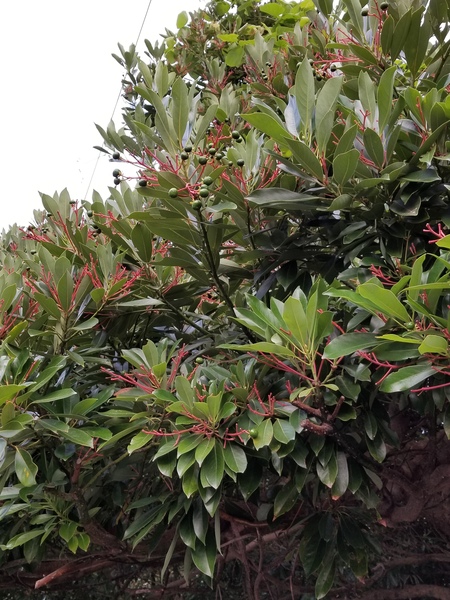
Machilus thunbergii ("Tabunoki")
Japanese name: タブノキ (椨)
Scientific name: Machilus thunbergii
[Overview]
An evergreen tree commonly found near the sea, reaching 20 m in height and 1 m in trunk diameter.
The twigs are reddish green.
The buds are large and ovoid.
Leaves are simple and alternate, tend to cluster at the branch tips, and are obovate-oblong, 8–15 cm long and 3–7 cm wide, with entire margins.
The upper surface of the leaf is glossy, and the underside is tinged with white.
Young leaves are red.
The petiole is 2–3 cm long.
Panicles arise from the leaf axils at the branch tips and bear many yellowish-green flowers about 1 cm in diameter.
The fruit is spherical, 1 cm in diameter, and ripens to blackish purple, with a red fruit stalk.
[Uses]
The branches and leaves are rich in mucilage and, when dried, become tabu powder (tabu-ko), a material for incense sticks and mosquito coils.
The bark and leaves are used as dyes, and on Hachijojima they are used to produce the reddish-brown (kaba-iro) color of Ki-hachijo.
The wood does not rot easily and is used for construction, furniture and carving.
It is resistant to sea wind, strong wind and air pollution, and it also serves as a fire-resistant tree.
[Cultivation]
It is resistant to pests and diseases and is easy to grow.
It grows well in a sunny, well-drained soil.
It often grows in moderately moist to slightly moist, fertile soil, and its vigor declines in dry, poor soil.
It is more cold-hardy than Kusunoki.
Details
Translated from our Japanese encyclopedia. If anything differs, the Japanese page is correct.