
Plant Encyclopedia

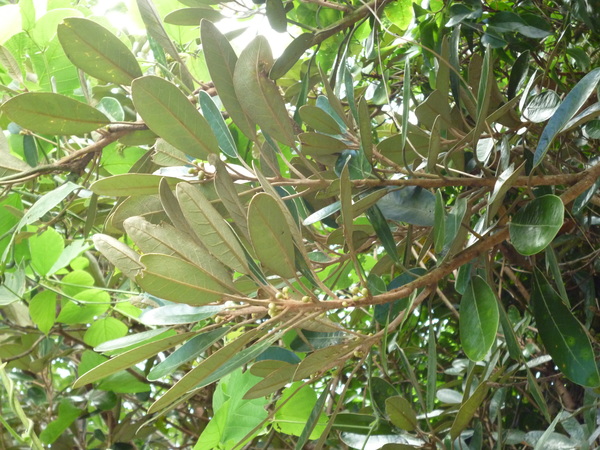
Litsea japonica ("Hamabiwa")
Japanese name: ハマビワ (浜枇杷)
Scientific name: Litsea japonica
[Overview]
An evergreen tree growing near the sea, reaching 10 m in height.
It sometimes becomes dominant and forms coastal forests.
Young branches are thick, and together with the petioles, the undersides of the leaves and the inflorescences, they are densely covered with yellowish-brown woolly hairs, giving a velvety texture.
Leaves are simple and alternate, clustered at the branch tips, oblong, 7–15 cm long and 2–5 cm wide, with rounded tips, a thick leathery texture and entire margins.
The upper surface of the leaf is deep green and glossy, and the underside is densely covered with yellowish-brown woolly hairs.
The petiole is 1.5–4 cm long.
The plant is dioecious.
A few small cream-colored flowers are borne in umbels arising from the leaf axils.
While in bud, the inflorescence is enclosed in an involucre and is spherical, with a curved stalk.
The corolla is 6-lobed.
The fruit is an elliptical berry 1.5–1.8 cm long that ripens to blackish purple, and its lower part is enclosed in a cup-shaped receptacle.
[Cultivation]
Propagate from seed.
Plants grown from seed will turn out to be both male and female.
It is suited to planting in warm regions from the coastal areas of the Kanto region westward.
It dislikes being transplanted.
It prefers a sunny, well-drained, fertile soil.
For plants in the ground, once established, watering is unnecessary unless sunny weather continues in midsummer and the soil becomes extremely dry.
For fertilizer in winter, dig a hole around the plant and bury compost.
Sooty mold can occur.
[Notes]
The Japanese name refers to its growing on the seashore and compares its leaves to biwa leaves.
Details
Translated from our Japanese encyclopedia. If anything differs, the Japanese page is correct.