
Plant Encyclopedia

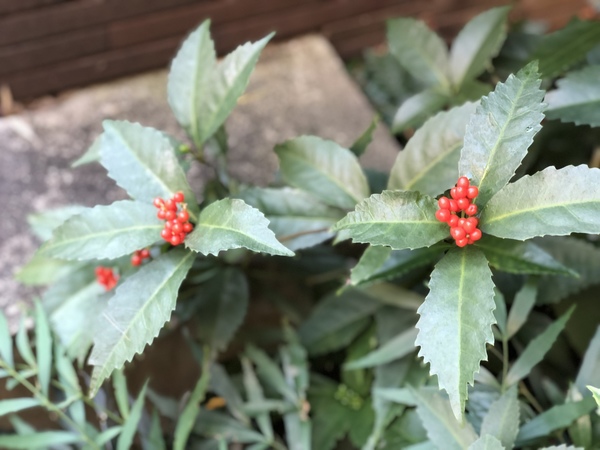
Sarcandra glabra (chloranthus, "Senryo")
Japanese name: センリョウ (千両)
Scientific name: Sarcandra glabra
[Overview]
An evergreen shrub 50–150 cm tall, found in evergreen forests.
The stems are erect, sparsely branched, and green.
Leaves are simple and opposite, oblong, 6–15 cm long and 2–6 cm wide, with a pointed tip and wavy margins bearing sharply pointed teeth.
The leaf surface is slightly glossy.
The petiole is 0.5–2 cm long.
Spikes 2–4 cm long, branching 2–3 times, are produced at the branch tips.
The flowers are small and yellowish green, without petals.
The fruit is spherical, 5–6 mm in diameter, and ripens red.
[Uses]
Because its leaves stay green in winter and it bears red fruit in winter, it has long been planted in gardens as an auspicious plant and used for New Year decorations in the tokonoma (alcove) and for flower arrangements.
The branches and leaves are called kyusetsucha and used medicinally.
[Cultivation]
Propagate from seed or by cuttings.
When growing from seed, completely remove the pulp from fully ripe fruit and sow the seeds alone immediately after harvest.
The suitable area for planting is southern Kanto and areas to the south.
It prefers bright shade and fertile, well-drained, moderately moist soil in a place not exposed to strong wind.
It is good to plant it on the east side of a building or in the shade of evergreen trees.
Strong sunlight scorches the leaves, and if it is too dark, fruiting is poor.
In winter, protect it from cold wind, and in cold regions give it protection against the cold.
For potted plants, water when the soil surface dries.
For plants in the garden, watering is unnecessary unless the soil becomes extremely dry.
Fertilizer is not particularly necessary, and fertilizer high in nitrogen makes only the foliage grow thickly, so that flowers and fruit are less likely to form.
Cut old branches that no longer flower off at ground level.
There are no particular pests or diseases.
Details
Japanese: センリョウ(千両)
Translated from our Japanese encyclopedia. If anything differs, the Japanese page is correct.