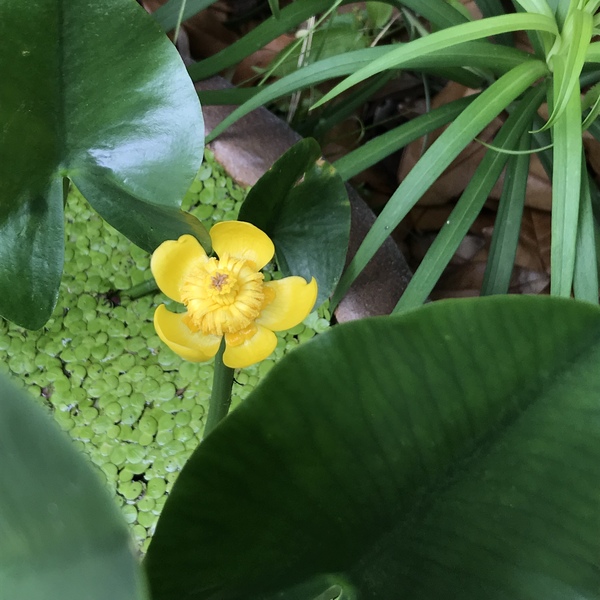
Nuphar japonica(East Asian yellow water-lily, "Kohone")
Japanese name: コウホネ(河骨、川骨) Scientific name:Nuphar japonica
[Overview]
A perennial growing in shallow ponds and marshes.
A thick white rhizome creeps horizontally underground.
There are submerged leaves and aerial leaves, both arising from the base.
The aerial leaves are arrowhead-shaped, 20–52 cm long and 10–26 cm wide, and stand out above the water.
The leaves are thick and glossy, with entire margins.
The flower is borne singly on a long stalk extending above the water, and is yellow, 4–6 cm across.
What look like five petals are actually sepals, and inside are many petals formed from modified stamens.
The sepals turn greenish after flowering.
The fruit is a berry and ripens underwater.
[Uses]
The rhizome is used medicinally.
[Cultivation]
Propagate by division.
Plant it in a sunny place using heavy soil such as Arakida soil.
Keep the water at a depth where the leaves float on the surface.
For fertilizer, bury oil cake in the soil from spring to autumn.
In an aquarium, a water temperature of 15–28 °C, added CO2, and normal to strong light are suitable.
There are no particular pests or diseases.
[Notes]
The Japanese name likens the rhizome to a bone.