
Plant Encyclopedia

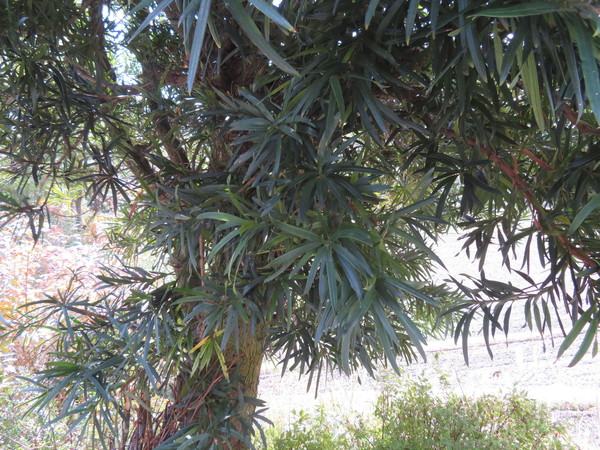
Podocarpus macrophyllus (yew plum pine, "Inumaki")
Japanese name: イヌマキ (犬槇)
Scientific name: Podocarpus macrophyllus
[Overview]
An evergreen coniferous tree growing in evergreen broadleaf forests in lowlands near the coast, 20 m tall with a trunk diameter of 50 cm.
The bark is grayish white and peels off in fine, thin vertical flakes.
The leaves are simple and alternate, linear, 10–20 cm long and 0.7–1 cm wide, with a conspicuous midrib.
The leaf margin is entire.
It is dioecious.
The male flowers are pale yellowish brown, with many stamens gathered into a cylinder 3 cm long, borne in clusters of 3–5 in the leaf axils.
The female flowers are borne singly in the leaf axils and are swollen at the tip, bearing a single ovule.
The seeds are green and covered with white bloom, and are borne in a row, in a daruma-like shape, together with the receptacle, which ripens reddish purple.
The seeds are poisonous, but the receptacle is sweet and edible.
In shade or in humid places, the seeds may sometimes root while still attached to the tree.
[Uses]
The wood is resistant to water and is used for tubs, roof boards, coffins and the like.
It is also planted as a homestead grove or a windbreak.
[Cultivation]
Propagate from seed or cuttings.
Remove the red receptacle from the seeds and sow them immediately, or store them without letting them dry and sow in spring.
It is planted from the coastal areas of southern Tohoku to Okinawa, but in central and northern Kanto it often suffers damage from cold wind.
It is a tree for warm regions, and especially while young its cold resistance is weak.
It is not particular about soil as long as the site is sunny and well drained.
It tolerates shade.
It tolerates wet ground and sea breeze, but declines in dry places.
For potted plants and plants within 2 years of planting in the ground, water thoroughly when the soil surface dries; for plants established in the ground, rainfall is sufficient.
For fertilizer in winter, dig holes around the plant and apply organic fertilizer.
It tolerates pruning, so it is easy to trim it into shape, but in cold regions finish by around October.
Pests and diseases include Pestalotia disease and the Kiobi-edashaku moth.
Details
Japanese: イヌマキ(犬槇)、クサマキ(草槇)
Translated from our Japanese encyclopedia. If anything differs, the Japanese page is correct.